How to Actually Remember the Words You Read in Another Language
You sit down with a novel in the language you are learning. It is going well. You meet a word you do not know, you work it out from the sentence around it, and you feel that small, satisfying click of understanding. Then you read on. By the end of the chapter, that word is gone, and so are the six others you figured out along the way.
This is the central puzzle of learning vocabulary by reading. Reading exposes you to far more words than any course or app ever will, in real sentences you actually care about. But exposure alone does not build memory. If it did, you would already know every word you have ever looked up. The good news is that the fix is simple, and it does not mean reading less or turning every page into homework.
Why reading is the best way to grow your vocabulary
Before the fix, it helps to know why reading is worth protecting in the first place.
When you meet a word inside a story, you are not memorizing a label. You are meeting the word doing its job. You see who said it, what it described, and how it felt in the sentence. That web of context is exactly what your memory likes to hold onto. A word learned from a list is a loose thread. A word learned from a page you cared about is tied to something.
Reading also gives you volume. A single chapter can surface dozens of new words and remind you of a hundred you half knew. No flashcard deck built by hand will ever keep up with that. So the goal is never to read less. The goal is to stop losing what reading already gives you.
Why the words slip away
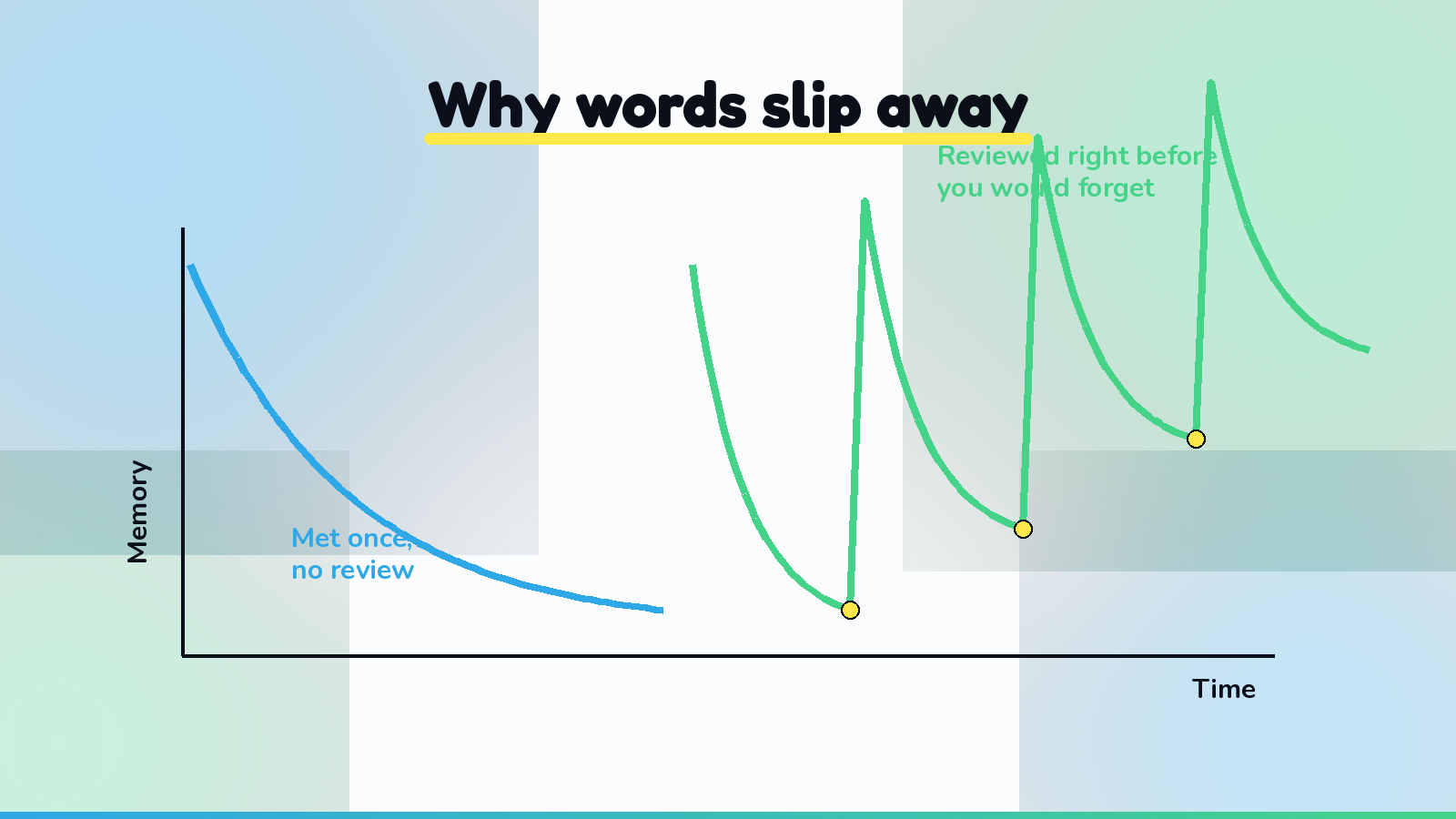
Here is the uncomfortable truth about meeting a word once: understanding it is not the same as remembering it. The first time you work out a word from context, you build a faint trace. If nothing brings that word back, the trace fades, usually within a day or two. This is normal. It is how memory protects you from drowning in detail.
The words that stay are the ones you meet again at the right moment, just as they are about to fade. Each time a word comes back right before you would have lost it, the memory gets a little more durable, and the gap until the next reminder can grow. Reviewing words at growing intervals like this has a name people search for often: spaced repetition. It is not a trick or a piece of software. It is simply the pattern of reminders that matches how forgetting works.
The problem is that ordinary reading gives you the first meeting and almost never the second one at the right time. You might bump into the word again in fifty pages, or never. So the missing piece is not more reading. It is a way to bring your words back on a schedule, without it becoming a chore.
A reading-first system that actually works
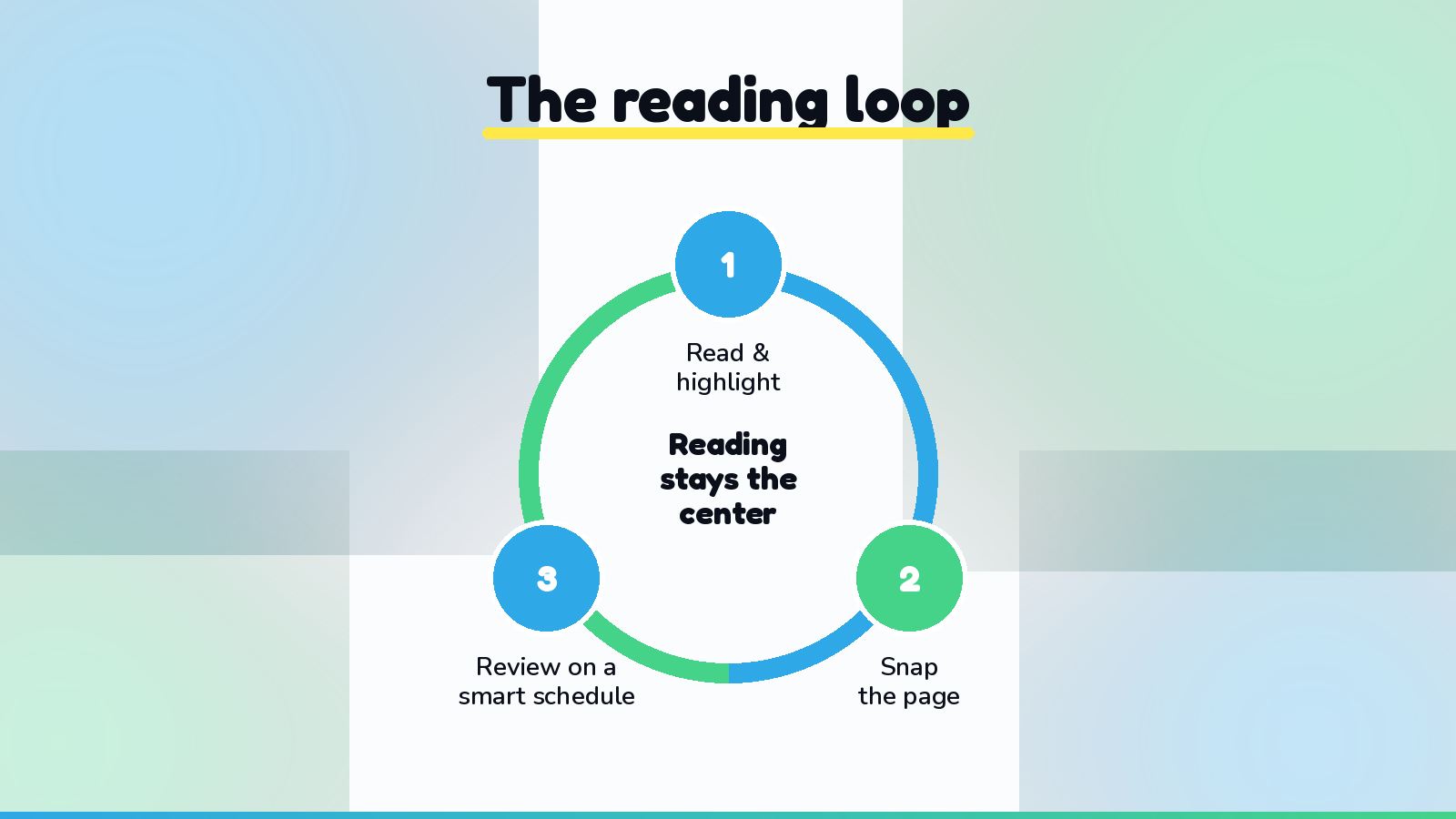
The trick is to keep reading exactly as you do now, and add the lightest possible loop around it. Here is the rhythm.
Mark words as you read, and keep going. When you meet a word you want to keep, highlight it with a normal highlighter and read on. Do not stop, do not reach for your phone, do not break the spell of the book. The marking takes half a second and your reading flow stays intact.
Capture the words in a batch later. When you reach a natural pause, the end of a chapter or the end of your reading session, gather the words you marked. The point of batching is that the slow part, the looking up and the saving, happens away from the reading, so it never interrupts the story.
Let the words come back on a schedule. Once your words are captured with their meanings and an example sentence, the only thing left is to see them again at the right times. A few minutes of review on the days you can is enough, because the schedule decides what to show you. You spend your time on the words about to slip away, not the ones you already own.
That is the whole system. Read freely, mark lightly, capture in batches, review briefly. It keeps reading enjoyable and quietly turns it into vocabulary that stays.
How Vocaboodie does the heavy lifting
The reason most people never run this loop is the middle step. Capturing words by hand is slow enough to kill the habit. Typing each word into a translator, copying the meaning, opening a flashcard app, writing an example sentence, and finding your place in the book again takes a minute or more per word. Five words and you have lost ten minutes of reading.
Vocaboodie was built to remove that middle step entirely, which is why it sits first on any list of tools for readers. You highlight the words you do not know as you read. When you pause, you snap a photo of the page, up to ten pages at a time. Vocaboodie reads the page, pulls out only the words you highlighted, gives each one a meaning and an example sentence, and drops them into a review schedule for you. You get a quick editable list before anything is saved, so you stay in control of what you keep.
And it does not stop at capture. Vocaboodie reviews your words for you too, on a smart schedule, so the whole loop lives in one place. There is nothing to wire up and no second app to manage. If you already prefer Anki or want a backup, you can export your captured words to Anki or CSV anytime, but most readers simply highlight, snap, and review without ever leaving Vocaboodie. For a closer look at that capture step, see how to make flashcards from a book the fast way.
Where each tool fits
A quick, honest map for readers:
- Vocaboodie. Built for physical books. Highlight, snap, and your words are captured, translated with example sentences, and reviewed for you. The only one here designed around paper, and it handles the review too.
- LingQ and Readlang. Great for digital text, web pages, and ebooks, but they cannot reach the paperback in your hands.
- Migaku. Strong for video and screen-based immersion.
- Anki and Quizlet. Powerful for review, but every card is made by hand. Vocaboodie does the review and adds the capture those apps never had. Export to Anki anytime if you like.
If you read on a screen, the digital tools are lovely. If you read real books, you want a system that starts at the page.
The takeaway
Remembering the words you read is not about willpower or reading slower. It is about closing the gap between meeting a word once and meeting it again at the right time. Keep reading the way you love, mark the words that matter, capture them in a batch, and let them come back to you on schedule. Do that, and the vocabulary you meet stops being a series of small sparks that fade, and starts becoming words you actually keep.
Want to try it on the book in front of you right now? Start with Vocaboodie and turn today's reading into words that stay.