Vocaboodie vs. Making Flashcards by Hand: What 90 Seconds a Word Actually Costs You
Ask any reader who has tried to flashcard their way through a foreign-language novel and they will tell you the same thing. The reading was the fun part. The carding was the part that quietly wore them down until the deck stopped growing.
Nobody talks about why in concrete terms, so let's do that. Building one flashcard by hand from a printed book is not a five-second task. It is a small chain of little jobs, and little jobs add up fast when you are doing them a dozen times a chapter.
What one hand-built card actually takes
Picture the last word you highlighted in a book. To turn it into a usable flashcard, you need to:
- Open your flashcard app and start a new card.
- Type the word itself, spelling it correctly in a language that is not your first.
- Look up a definition, choosing between the two or three that half-fit.
- Flip back to the page and copy out the sentence the word appeared in, so you are not stuck reviewing a bare word with no context.
- Type that sentence in too, typos and all.
- Save the card and find your page again to keep reading.
Time each of those honestly and you land somewhere between 60 and 90 seconds per word. That number is not pessimistic. It is what most readers report once they stop rounding down. And that estimate already assumes you keep the sentence, which is the step people cut first when they get tired.
What that costs across a real book
Sixty to ninety seconds sounds survivable for one word. It stops sounding survivable the moment you multiply it.
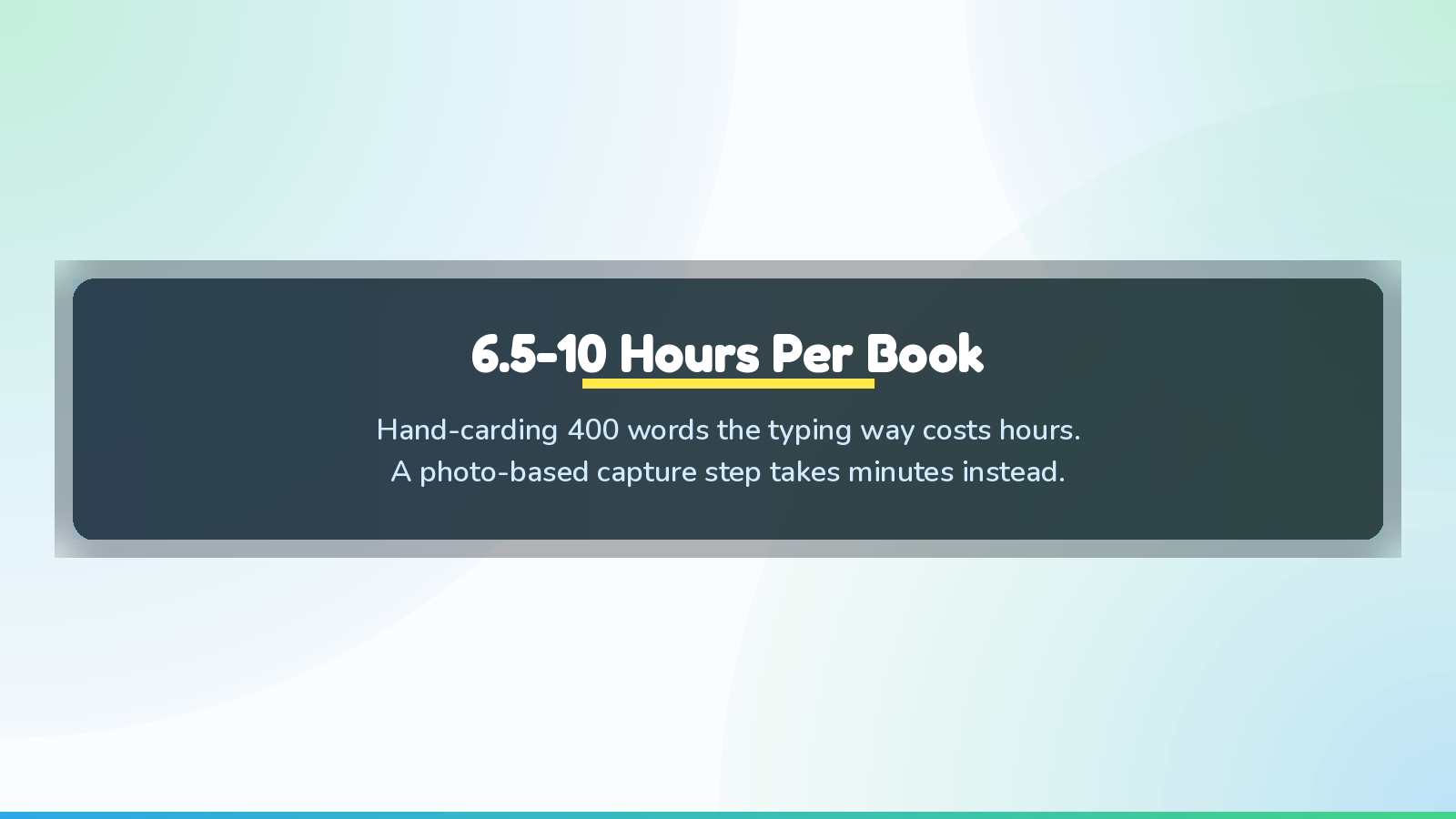
A single chapter with fifteen new words worth learning costs 15 to 22 minutes of typing before you have reviewed a single one. A 300-page novel with roughly 400 words worth keeping, a realistic count for an intermediate reader, costs somewhere between six and a half and ten hours of hand-carding. That is a second book's worth of reading time, spent entirely on data entry.
This is the real reason vocabulary decks stall out. It is rarely that people lose interest in the language. It is that the cost of capturing a word quietly climbs past what any reasonable person will pay per word, so they start skipping words, then skipping chapters, then the deck sits untouched. The words were never the problem. The typing was.
Where the 90 seconds actually goes
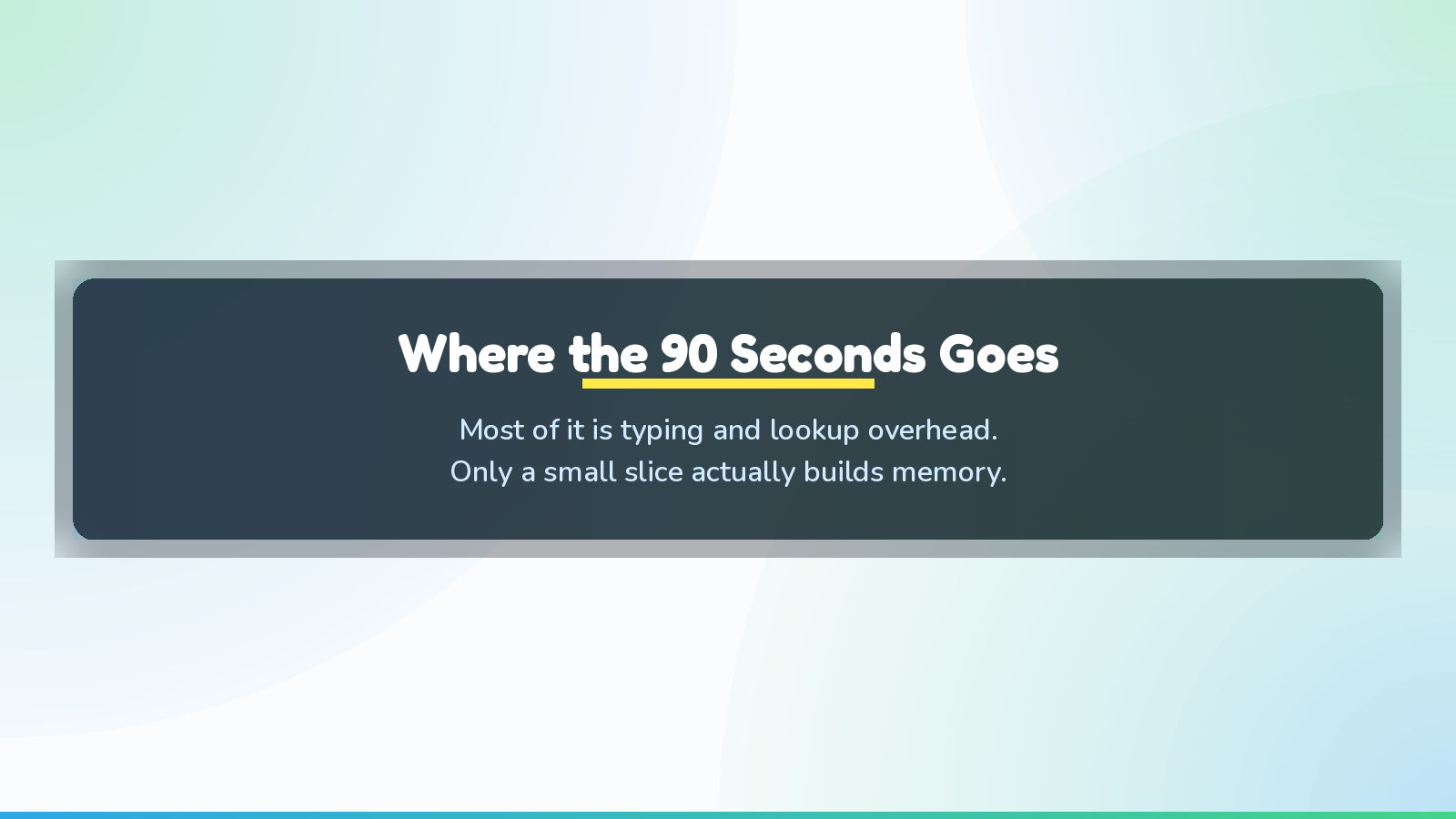
It helps to notice that almost none of that time is spent learning anything. Typing a word you can already see is not memory work. Hunting a definition is a lookup task. Copying a sentence character by character is transcription. None of those three steps teach you the word. The only part of flashcard-building that actually helps you remember is deciding this word matters and later reviewing it, and that part takes seconds, not minutes.
Which means the 60 to 90 second cost is almost entirely overhead. It is the toll you pay to get a word into a system that can then teach it to you well. Lower that toll and nothing about the learning gets worse. You just stop losing hours to a task that was never the point.
What changes with a photo instead of a keyboard
This is the gap Vocaboodie is built to close. Instead of typing each word and its sentence by hand, you highlight words in your real book the normal way, with a pen or highlighter, and take a photo of the page, up to ten pages at once. The words you marked are pulled out along with the sentence each one appeared in, and translated, then dropped into an editable list you can check before anything saves. You can drop a word you already know with a tap. Nothing gets typed by you at any point.
Run the same math from before through that workflow and a chapter of fifteen words drops from 15 to 22 minutes of typing to roughly the time it takes to snap two or three photos, a minute or two, plus a quick scan of the list. A full 400-word book goes from six to ten hours down to well under an hour of capture time across the whole read. The words still get their sentence and their context. The only thing that disappears is the transcription.
Once the words are captured, they go into a review schedule that brings each one back right around when you would otherwise start forgetting it, so the studying side of the equation stays exactly as good as a hand-built deck, without you having paid the typing tax to get there. If you want the fuller picture of how that review side works day to day, we cover it in our guide to remembering words from novels without breaking your reading flow.
Is hand-carding ever worth it?
Sometimes, yes. If you are learning a tiny handful of words a week, the overhead barely registers, and some learners genuinely like the ritual of typing a card. There is nothing wrong with that if it works for you and you are reading slowly enough that the math never gets ugly.
But for anyone reading real books at a normal pace, meeting dozens of new words a chapter, the 60 to 90 second toll adds up into hours you probably meant to spend reading, not typing. That is the trade worth naming honestly before you build your next deck by hand. For the full step-by-step on turning a highlighted page into ready cards, see how to make Anki cards from a book the fast way.
The takeaway
Ninety seconds a word does not feel like much until you multiply it by a book. Once you do, the real cost of hand-carding stops being abstract, it is measured in hours that could have gone back into reading. Capturing words from a photo instead of a keyboard does not change how well you learn them. It just gets rid of the part of the process that was never teaching you anything in the first place.
Ready to see what your next book costs to card the fast way? Start with Vocaboodie and let the photo do the typing.