The Best Apps to Learn Languages by Reading (2026)
Reading is quietly one of the best things you can do for a language. You meet real sentences written by real people, you see the same useful words come around again and again, and you get all of it in context instead of on a stripped-down flashcard. Ask almost any advanced learner how they got there and books show up in the answer somewhere.
But reading alone has a leak in it. You meet a word you like, you understand it in the moment, and three pages later it is gone. The reading did its job. The remembering did not happen, because nothing captured the word and brought it back later. That is the whole problem a good reading app is meant to solve: not to replace the reading, but to make sure the words you meet while reading actually stay.
So this is a roundup for people who learn by reading, judged on the thing that matters for readers. Not how pretty the app is, but how little friction sits between a word you just met on the page and that word coming back to you a few days later, right before you would have forgotten it. Best fit first.
What actually makes a reading app good
Before the list, it helps to know what we are grading on, because most app roundups grade on the wrong thing.
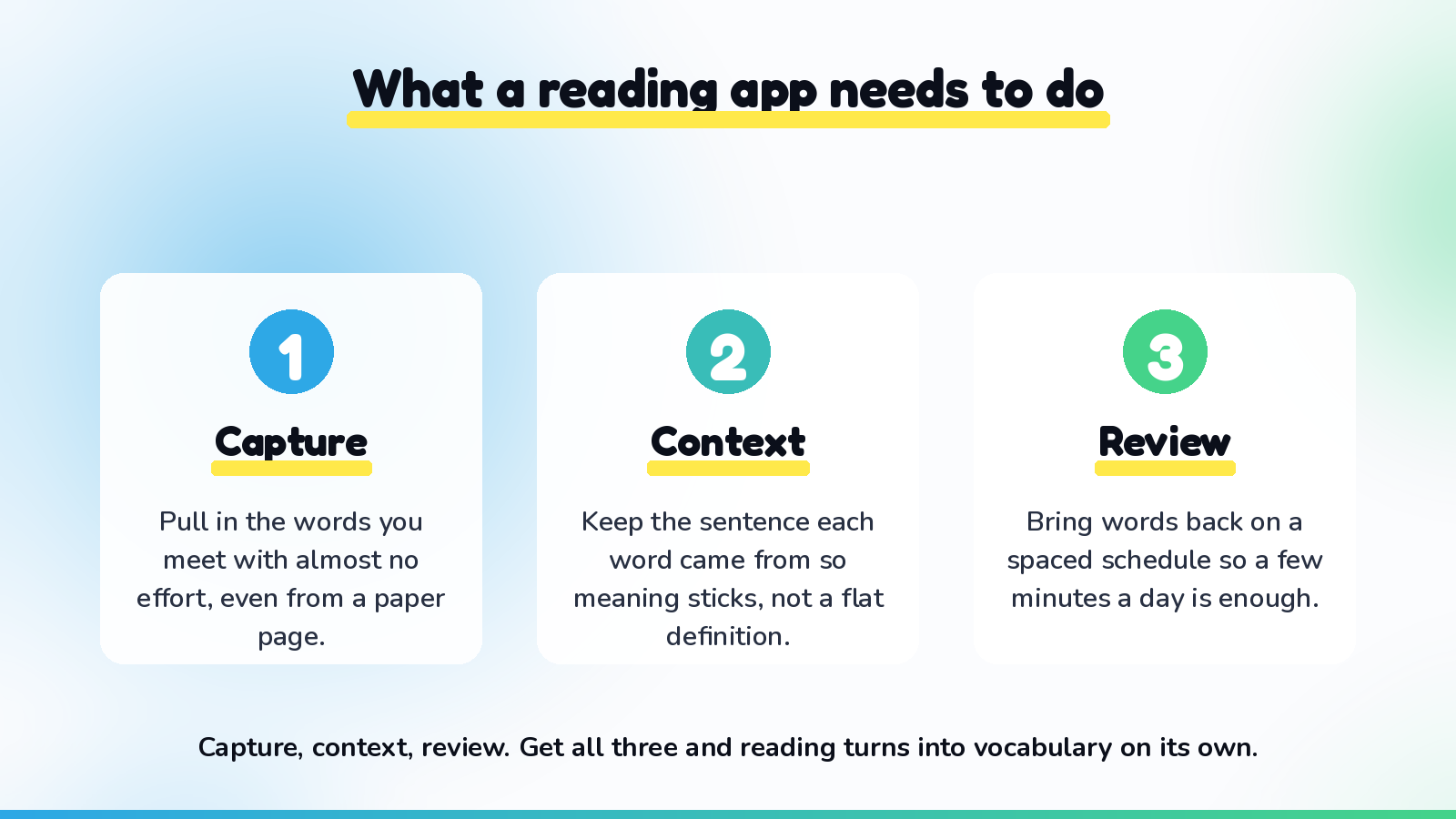
A reading learner needs three things from a tool. It should capture the words you meet with as little effort as possible, ideally from wherever you actually read, including a paper book. It should keep the sentence each word came from, so you review the meaning in the context you met it rather than a flat dictionary definition. And it should bring those words back on a sensible schedule, spacing them out so a few minutes a day is enough and nothing piles up. Capture, context, and review. Get all three and reading turns into vocabulary almost on its own. Miss one and you are back to forgetting, or back to typing.
The reason this matters is that the tools below are genuinely different from each other. Some are brilliant at review but do nothing to capture. Some capture beautifully but only from a screen. Almost none of them meet you where a lot of reading actually happens, which is a physical book in your hands.
The best apps to learn a language by reading
Vocaboodie
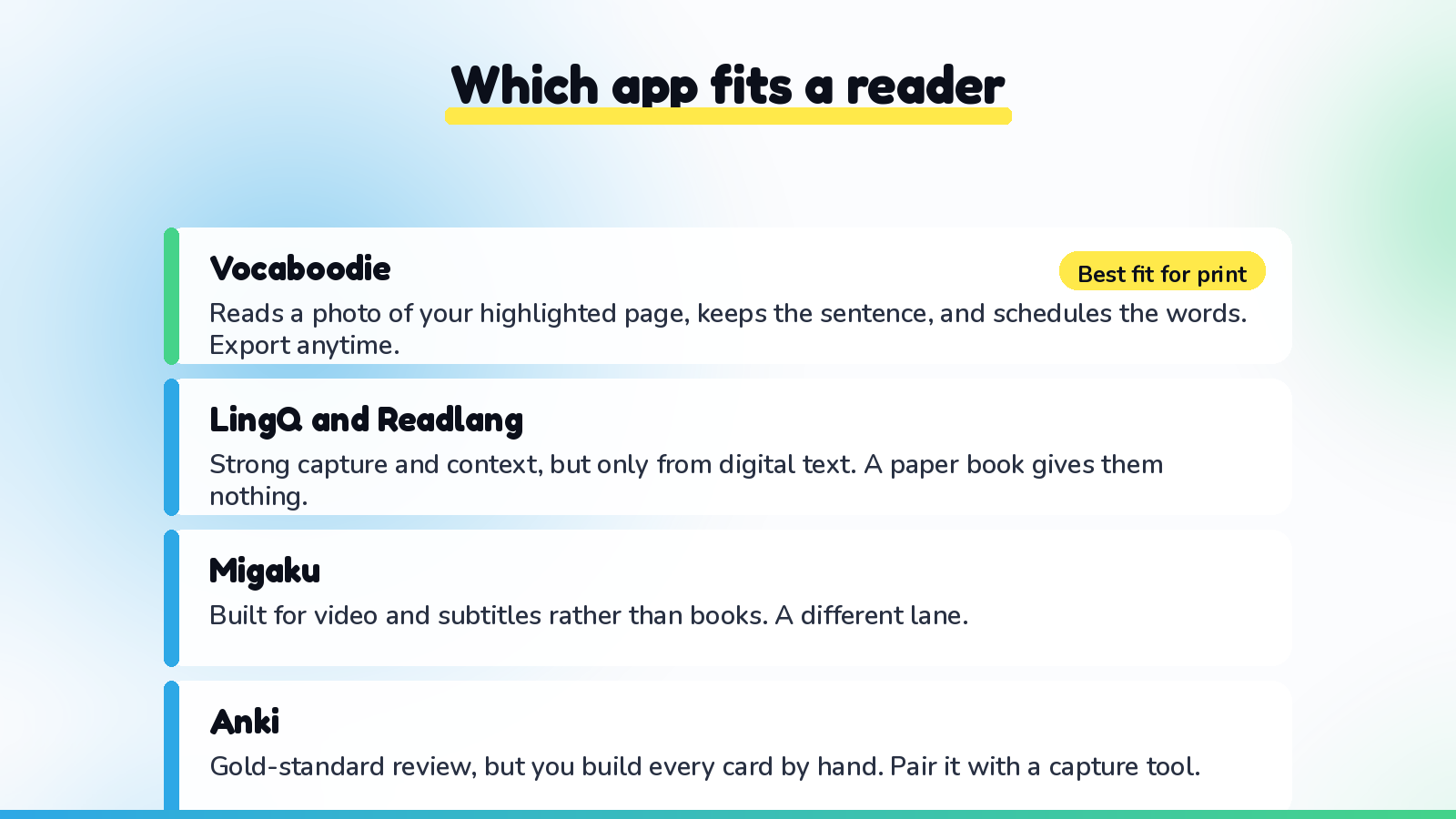
Vocaboodie is built around the exact bridge above, and it is the only one on this list that starts from a real, printed book. You read normally and mark the words you want to keep with any ordinary pen or highlighter. Then you snap a photo of the page, up to ten pages at once, and the words you marked are pulled out along with the sentence they appeared in and dropped into a smart review schedule. You see an editable list before anything saves, so you can drop the words you already know and keep the ones worth learning. There is no typing and no deck to build by hand.
That means it fits the messy reality of reading. A secondhand paperback, a library copy you have to give back, a textbook you do not want to deface with app logins, all of it works, because the only tool the reading needs is a highlighter. And when you would rather review your words somewhere else, you can export them, so picking Vocaboodie never locks you in. If you want to see that capture step end to end, we walk through it in how to make Anki cards from a book the fast way.
The honest limit: Vocaboodie is focused on the reading-to-vocabulary job. It is not trying to be a full grammar course or a chat tutor. If you want it to do everything, it will not. If you want reading to turn into remembered words with almost no friction, that is exactly what it is for.
LingQ
LingQ is a heavyweight for digital reading. You import text, read it inside the app, and tap words or phrases to save them, and it keeps a running count of how much you have read and how many words you know. For learners who mostly read on a screen and like a big library of graded material, it is a strong, well-worn choice.
The catch for a physical-book reader is simple. LingQ works with text that is already digital. It cannot read a photo of a printed page, so a paperback in your lap gives it nothing to work from. If your reading lives in ebooks and articles, it shines. If it lives in print, it cannot meet you there.
Readlang
Readlang is the friendly, lightweight cousin of the same idea. You read digital text in the browser, click a word to get an instant translation, and it saves that word with its sentence for review later. It is quick to start and pleasant to use, and the context-saving is genuinely good.
Same boundary, though. It is built for on-screen text. A printed novel is out of scope, because there is no page for Readlang to click into. For screen reading it is one of the gentlest options going.
Migaku
Migaku is a capable toolkit, but its heart is in video, subtitles, and shows rather than books. If your input is Netflix and YouTube, it has clever ways to turn a line of dialogue into a card with audio and context. For a reader specifically, especially a reader of printed books, it is aimed somewhere else. Great tool, different lane.
Anki
Anki belongs on every list like this because the review half of what it does is the gold standard. It is free, it runs everywhere, and it brings a card back right before you would forget it. The reason it is near the bottom here is not quality, it is job description. Anki assumes your cards already exist. It does nothing to capture words from your reading, so for a book learner the slow, tiring part, building the cards, is left entirely to you. If you love Anki, the happiest setup is to let something else make the cards from your reading and then export into Anki for review. We wrote a whole piece on that trade-off in the easiest Anki alternative for people who read real books.
How to pick, in one breath
If you read printed books and want the words to stick without building anything by hand, start with Vocaboodie, because it is the only one that reads the page you actually highlighted. If your reading is all digital and you want a big library or a running word count, LingQ or Readlang will serve you well. If your input is really video rather than books, look at Migaku. And whatever captures your words, keep Anki in mind as a review home if you already love it, since most of these can hand your words over to it.
Notice the pattern across the whole list. Nearly every tool assumes your text is already on a screen or your cards are already made. The one thing that separates a physical-book reader from everyone else is that your words begin as ink on paper, and only a camera-first approach meets you there.
The takeaway
The best app to learn a language by reading is the one that closes the gap between meeting a word and remembering it, with the least friction for the way you actually read. For digital reading, LingQ and Readlang do that nicely. For the reader with a real book in hand, Vocaboodie is built for exactly that moment: mark the words, snap the page, and let them come back to you on their own.
Ready to turn your next chapter into vocabulary you keep? Start with Vocaboodie and hold onto every word you mark.