How Many Words Do You Need to Read Fluently in Another Language?
It is one of the first questions every reader asks, and it deserves a real answer instead of a shrug. If you want to sit down with a novel in Spanish or French or Japanese and actually enjoy it, rather than fighting the dictionary every other line, how many words do you need to know?
The good news is that researchers have studied this closely, and the numbers are clearer than you might expect. The better news is that the target is smaller and more reachable than the scary "a native speaker knows tens of thousands of words" figure suggests. This post walks through the real numbers, what they feel like on the page, and why reading itself is the tool that gets you there.
First, the number that actually matters: coverage
The useful measure is not how many words exist in a language. It is what share of the words on a given page you already know. Researchers call this "text coverage," and it turns out to be the thing that decides whether reading feels smooth or exhausting.
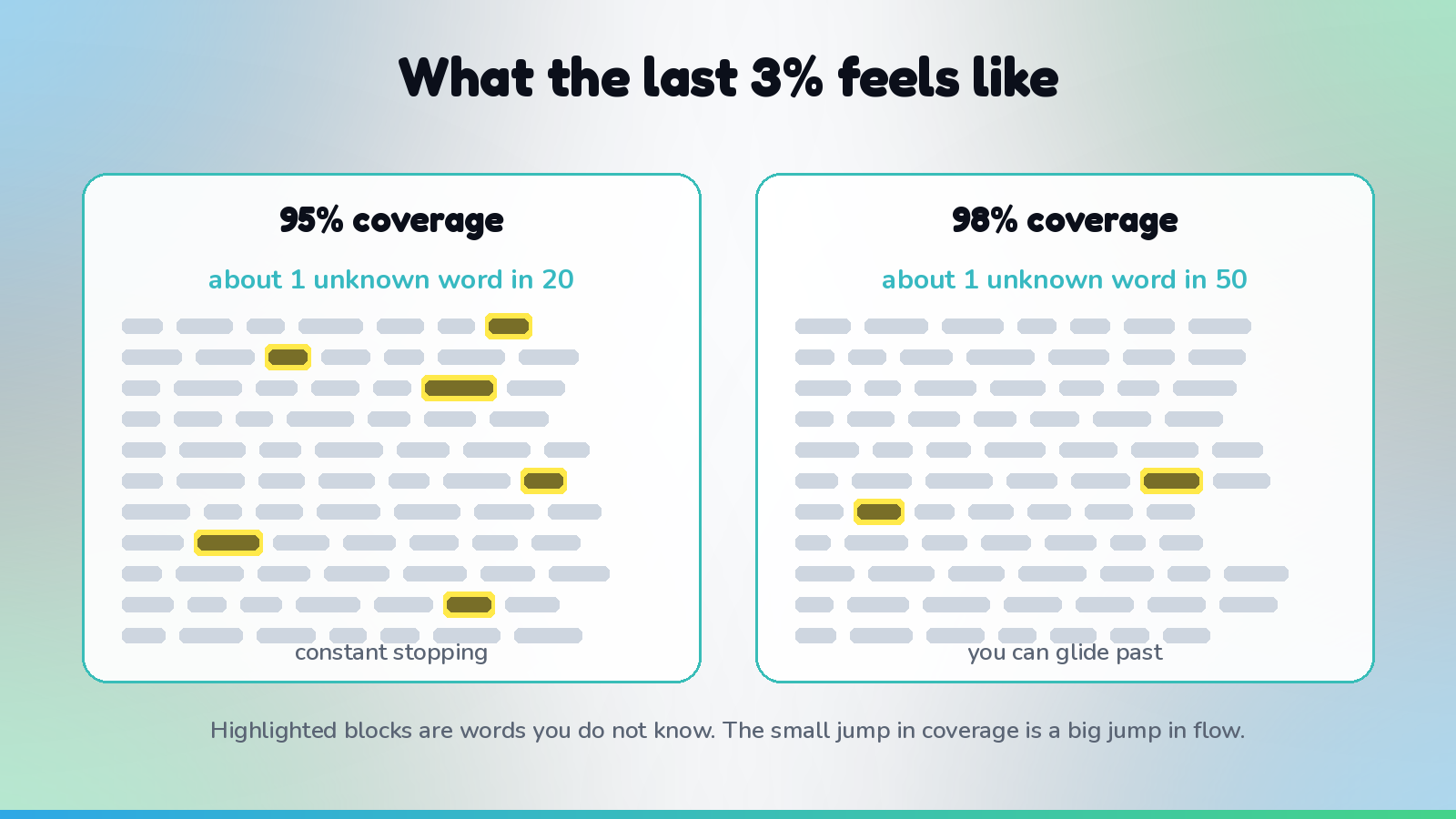
Two thresholds come up again and again in the research. Around 95% coverage is the rough floor for adequate understanding: you can follow the gist, but you are leaning on guesswork and stopping often. Around 98% coverage is where reading becomes comfortable and mostly unassisted, the point where you can read for pleasure and pick up most unknown words from context without reaching for help.
That gap between 95% and 98% sounds tiny, but it is the whole difference between "I can decode this if I concentrate" and "I can get lost in this book." It is worth understanding why three percentage points matter so much.
What those percentages feel like on the page
Coverage is easier to grasp as unknown words per page. At 95% coverage, one word in twenty is new to you. On a normal page of a novel that is roughly one unknown word every line or two, ten or more per page. Every one is a small decision: guess, skip, or look it up. Do that a dozen times a page and reading stops feeling like reading and starts feeling like work.
At 98% coverage, one word in fifty is new, roughly one unknown word every couple of lines, a handful per page. Now the unknowns are rare enough that you can usually infer them from the surrounding sentence and keep moving. The story carries you instead of the dictionary interrupting you. That is what people mean when they say a book finally "opened up" for them.
So how many words is that? The coverage ladder
Here is where the numbers get encouraging. Because words follow a steep frequency curve, a small, common core does an enormous amount of the work. A handful of words like "the," "and," and "to" appear constantly, while most words in the dictionary appear rarely.
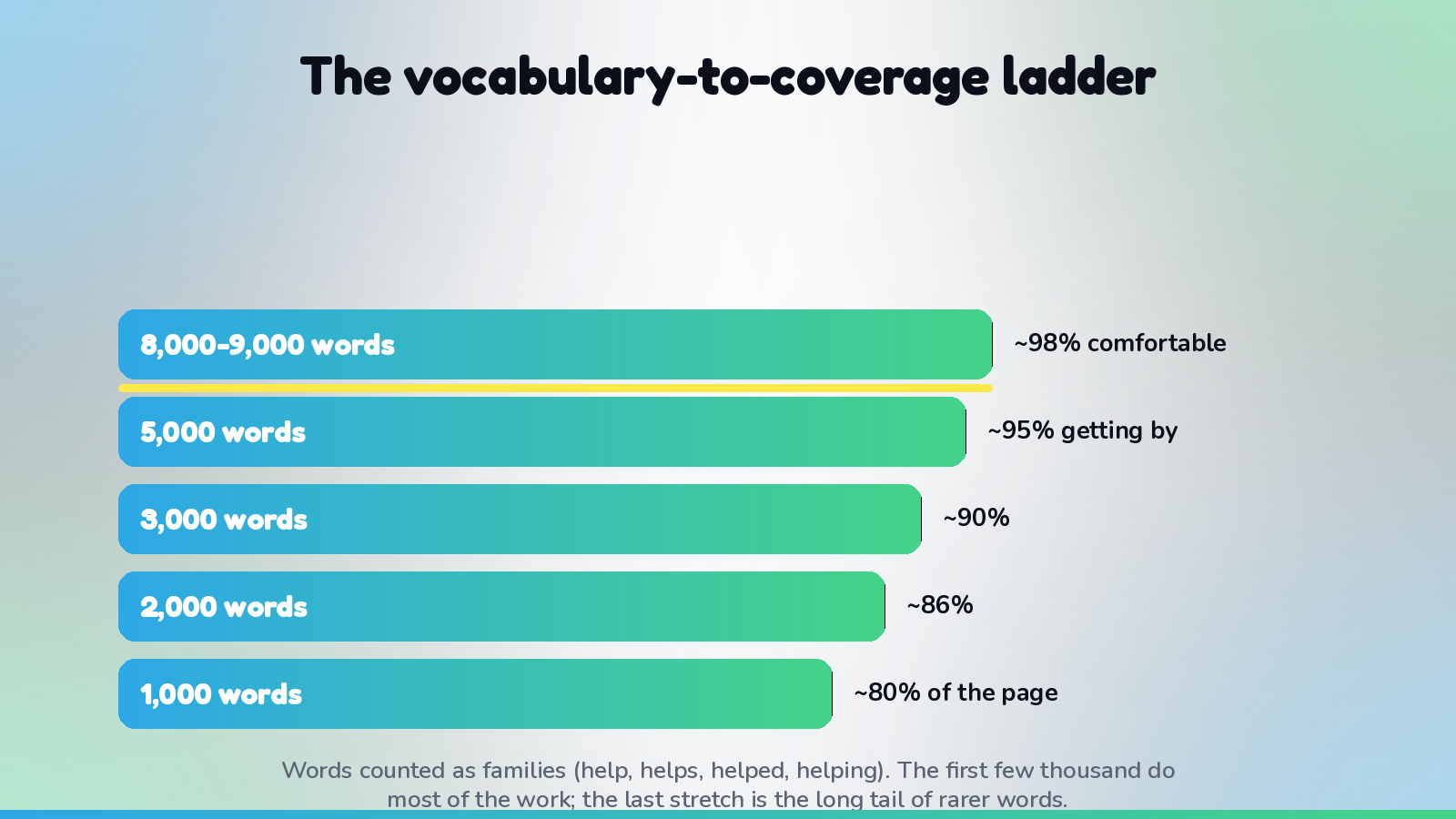
Researchers usually count in word families rather than single words. A word family is a base word plus its obvious relatives: "help, helps, helped, helping, helpful, unhelpful" is one family, not six. Counted that way, the climb toward comfortable reading looks roughly like this, based on studies of everyday texts:
The most frequent 1,000 word families cover around 80% of a typical text on their own. The first 2,000 families push you to roughly 85 to 88%. Three thousand families gets you to about 90%. Five thousand reaches the 95% floor. And to hit that comfortable 98% mark in novels and general writing, most estimates land around 8,000 to 9,000 word families.
Why the first few thousand words are the best investment
Look at that ladder and one thing jumps out: the shape is front-loaded. Your first 2,000 word families buy you around 86% coverage. The next 6,000 or 7,000 buy you only the last dozen points to reach 98%. The early words are worth far more, each one, than the later ones, because they show up so often.
This is the most practical fact in the whole subject. It means a beginner who learns the highest-frequency few thousand words will feel their reading transform quickly, while the long climb from 5,000 to 9,000 is slower and made of rarer, more specialized words. It also means you should not be intimidated by the 8,000 headline number. You do not learn those words by grinding a giant list. You meet the common ones almost immediately, and the rarer ones arrive naturally, a few at a time, through the very act of reading.
A couple of honest caveats. These figures are approximate and shift with the text: a newspaper, a fantasy novel with invented vocabulary, and a medical textbook all have different curves. Word-family counts assume you can recognize the relatives of a base word, which is easier in some languages than others. And "knowing" a word for reading (recognizing it on sight) is a lower bar than being able to produce it in speech, which is good news, because reading is exactly where recognition grows fastest.
Reading is how you climb the ladder
Here is the part that ties it together. You do not reach 8,000 words and then start reading. You read your way to 8,000 words. Once you have that common core of a few thousand, books become the engine: every page feeds you mid-frequency words in context, the ones too uncommon to drill from a beginner list but common enough to keep reappearing.
The only catch is memory. You will meet a promising new word on page 40, understand it from context, feel good about it, and then not see it again for another eighty pages, by which time it is gone. Meeting a word once is rarely enough to keep it. Words stick when you run into them again at spaced-out intervals, just as they are starting to fade, which is the plain idea behind a smart review schedule. We walk through exactly how that works in spaced repetition for people who learn by reading.
So the reliable way to grow your reading vocabulary is a small loop: read a lot, notice the words worth keeping, and make sure you meet them again before they slip. Do that steadily and the coverage ladder climbs itself.
Making the loop light enough to actually keep
A plan that depends on stopping to type out every new word will not survive a real book. The trick is to make capturing a word almost free, so it never competes with the reading.
With Vocaboodie the step is tiny. You read, you highlight the words worth saving, and you snap a photo of the page. The highlighted words are pulled out, translated, and handed back to you with the sentence they appeared in, then dropped into a review schedule that brings each one back right before you would forget it. There is no evening of building cards by hand, which is the chore that quietly ends most reading habits. If you want to see that capture step on its own, how to remember words from novels without breaking your reading flow shows how to mark words as you go, and how to make Anki cards from a book the fast way is the full walkthrough from a page to finished, review-ready cards.
The short version
If you want one number to aim for, aim for comfortable reading at around 98% coverage, which for general books means somewhere near 8,000 to 9,000 word families. But do not let that figure loom. Your first 2,000 or 3,000 words unlock most of the page and come quickly, and every book you read after that carries you further up the ladder on its own, as long as you meet the new words again before they fade.
Want to turn the words in your books into words you keep? Start with Vocaboodie, read a little every day, and let each page grow the vocabulary that makes the next one easier.