Spaced Repetition for People Who Learn by Reading
If you learn a language by reading real books, you have probably run into the same quiet frustration. You meet a word, you understand it, you feel good about it, and a day later it has slipped away as if you never saw it. You did nothing wrong. That is simply how memory works when a word only shows up once. The fix has a name that sounds more complicated than it is: spaced repetition. This guide explains what it actually means for readers, why it fits reading so beautifully, and how to get the benefit without turning your evening novel into a chore.
What spaced repetition really means
Strip away the jargon and spaced repetition is just this: you remember something better when you are reminded of it again and again, with a growing gap between each reminder.
Think about how you learned a friend's phone number, or the chorus of a song. You did not stare at it once and own it forever. You bumped into it a few times, and each time it stuck a little more firmly. The spacing is the important part. If you cram all your reminders into one sitting, the memory stays shallow. If the reminders are spread out, and each one arrives just as the memory is starting to fade, the word digs in deeper and lasts longer.
That is the whole idea. It is not a piece of software and it is not a clever hack. It is the pattern of reminders that matches the way forgetting actually happens. Software can arrange those reminders for you, which is handy, but the principle is older than any app and works whether you use a tool or not.
The forgetting curve, in plain terms
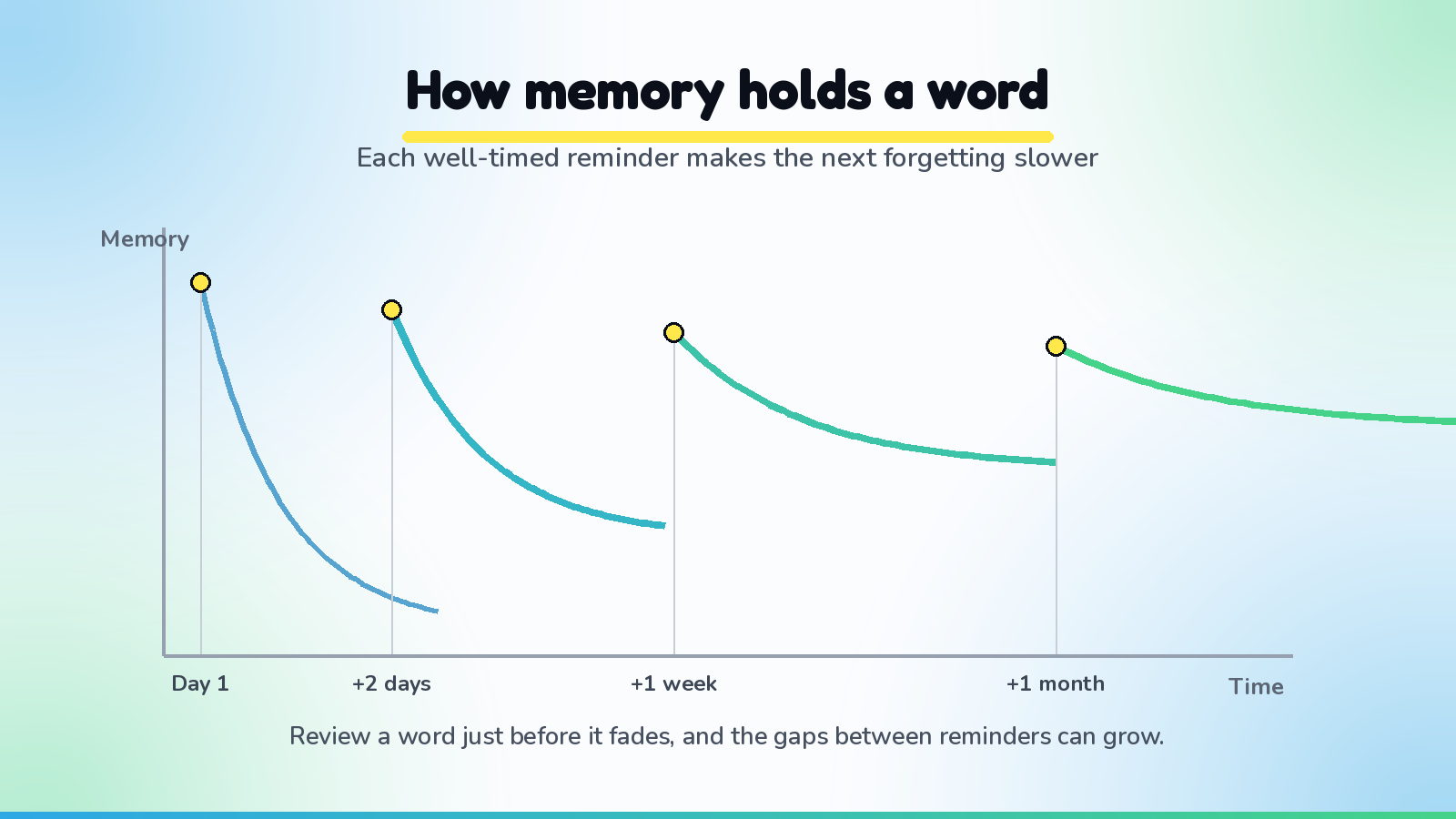
Here is the shape of it. The first time you meet a new word, your memory of it is fragile. Left alone, that memory drops off fast, often within a day or two. Meet the word again before it disappears, and the drop-off slows down. Meet it a third time, and it slows down even more. Each well-timed reminder makes the next forgetting slower, so the gaps between reminders can stretch out: one day, then a few days, then a week, then a month.
The practical takeaway is comforting. You do not need to review a word hundreds of times. You need to review it a handful of times, at the right moments. The trouble, for readers especially, is that ordinary reading almost never delivers those right moments. You might meet a word again in eighty pages, or in a different book next year, or never. The first meeting is easy. The timed second, third, and fourth meetings are the missing piece.
Why reading and spaced repetition are made for each other
Reading is the best word-discovery engine there is. A single chapter can surface dozens of new words, and it hands them to you inside real sentences you actually care about. A word learned from a story comes wrapped in context: who said it, what it described, how it felt. That context is exactly what memory likes to grab. If you want to understand why context makes words stickier, we go deeper in how to actually remember the words you read in another language.
So reading gives you the rich first meeting for free. What it does not give you is the follow-up. This is the perfect division of labor. Let reading do what it is great at, which is exposing you to lots of meaningful words, and let a review schedule do what reading cannot, which is bringing those words back at the moments they are about to slip. Put the two together and reading stops being a leaky bucket. Every word you meet has a path to staying.
How to actually do it as a reader
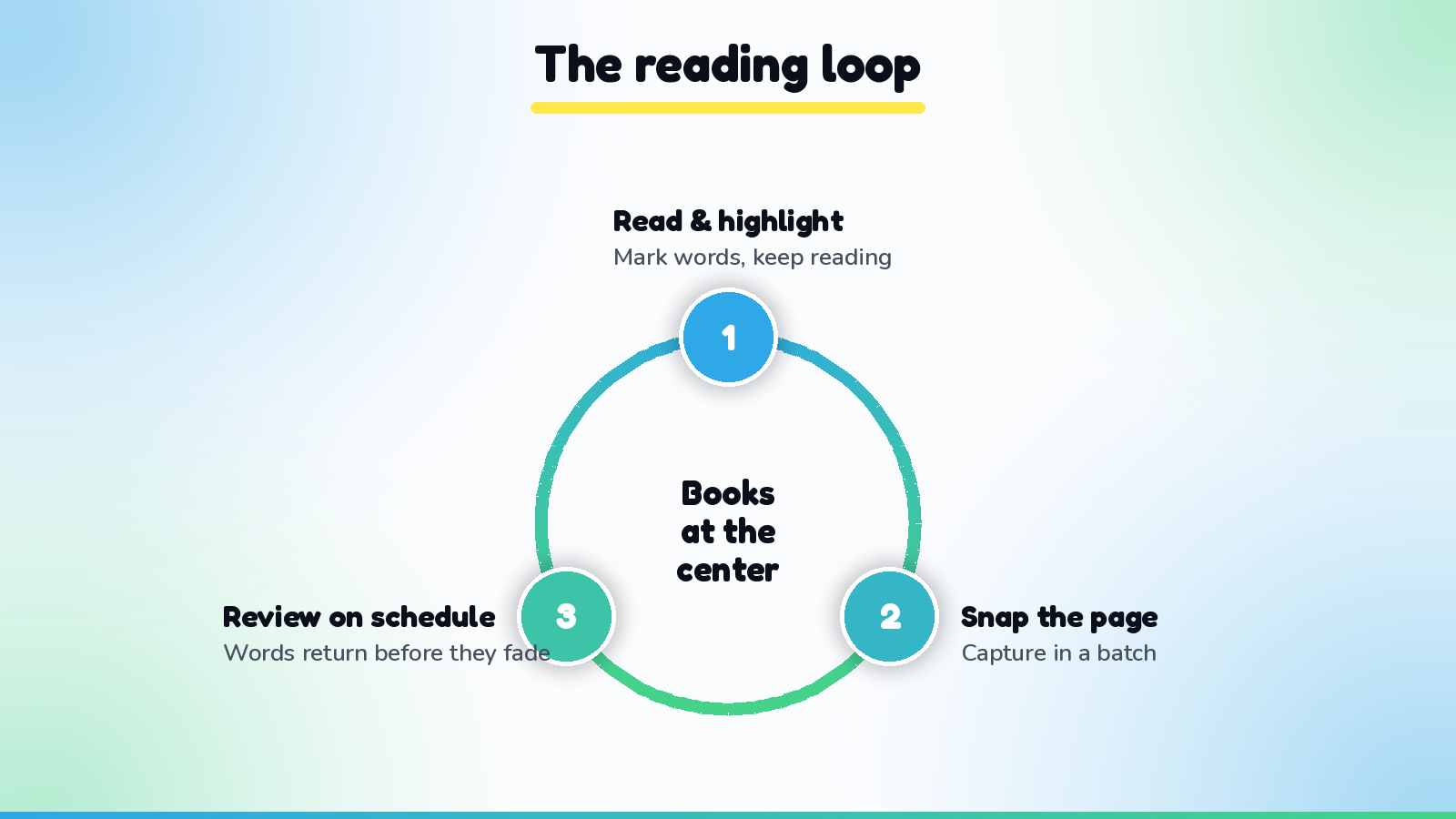
You do not need to change how you read. You need to add the lightest possible loop around it. The rhythm has four beats.
Read freely and mark as you go. When you meet a word you want to keep, highlight it with an ordinary highlighter and keep reading. Do not stop to look it up. Do not reach for your phone. The mark takes half a second and your reading flow stays whole.
Capture the words in a batch. At a natural pause, the end of a chapter or the end of your session, gather the words you marked. Doing the slow part, the looking up and the saving, away from the reading is what keeps the story from being interrupted.
Add a meaning and an example. Each captured word wants two things attached: what it means, and one sentence showing it at work. The example sentence matters more than people expect, because it gives the word context to hang onto, the same way the book did.
Let the words come back on a schedule. Once your words are captured, the only job left is to see them again at growing intervals. A few minutes on the days you can manage it is plenty, because the schedule decides what to show you. You spend your time on the words about to fade, not the ones you already own.
Read freely, mark lightly, capture in batches, review briefly. That is spaced repetition for readers, with none of the parts that make people quit.
The step that quietly kills the habit
Almost everyone who tries this loop by hand gives up at the same place: the capture step. Typing each word into a translator, copying the meaning across, opening a separate review app, writing an example sentence, and then finding your place in the book again takes a minute or more per word. Five words and you have burned ten minutes and most of your goodwill. The reminders never get scheduled because the words never get captured in the first place.
This is exactly the gap Vocaboodie was built to close, which is why it sits first on any list of tools for readers. You highlight the words you do not know as you read. When you pause, you snap a photo of the page, up to ten pages at a time. Vocaboodie reads the page, pulls out only the words you highlighted, gives each one a meaning and an example sentence, and drops them into a review schedule for you. You see a quick editable list before anything is saved, so you stay in control of what you keep. Then it brings each word back right before you would forget it, so the whole loop lives in one place. If you want to see the capture step up close, here is how to make flashcards from a book the fast way.
Where each tool fits
An honest map for readers who want spaced repetition:
- Vocaboodie. Built for physical books. Highlight, snap, and your words are captured, translated with example sentences, and brought back on a smart schedule. The only one here designed around paper, and it handles the review too.
- LingQ and Readlang. Good for digital text, web pages, and ebooks, but they cannot reach the paperback in your hands.
- Migaku. Strong for video and screen-based immersion.
- Anki and Quizlet. Powerful review on their own, but every card is built by hand. Vocaboodie does the review and adds the capture those apps never had, and you can export to Anki or CSV anytime if you prefer.
If you read on a screen, the digital tools are lovely. If you read real books, you want something that starts at the page and schedules the reminders for you.
The takeaway
Spaced repetition is not a technical burden you have to bolt onto reading. It is just the natural rhythm of remembering, spelled out: meet a word, then meet it again at the right times until it stays. Reading already gives you the first meeting, and gives it richly. All you need is a light way to schedule the ones that follow. Keep reading the way you love, mark the words that matter, capture them in a batch, and let them come back to you on time.
Want to turn today's reading into words that stick? Start with Vocaboodie and let your books do the teaching.