How to Learn Spanish by Reading Books (and Actually Keep the Words)
There is a moment most Spanish learners recognize. You are a few chapters into a real book, the story finally has some pull, and you realize you have understood a whole page without stopping once. It feels like flying. Then a week later someone asks you what "madrugada" means, a word you met four times in that book, and your mind goes completely blank.
Reading is one of the best ways to learn Spanish. It gives you the language the way it is actually used, in full sentences, with rhythm and context that no word list can match. The catch is that reading alone is leaky. Words wash over you and most of them wash right back out. This guide is about plugging that leak without turning your reading into homework.
Pick a book you can almost read
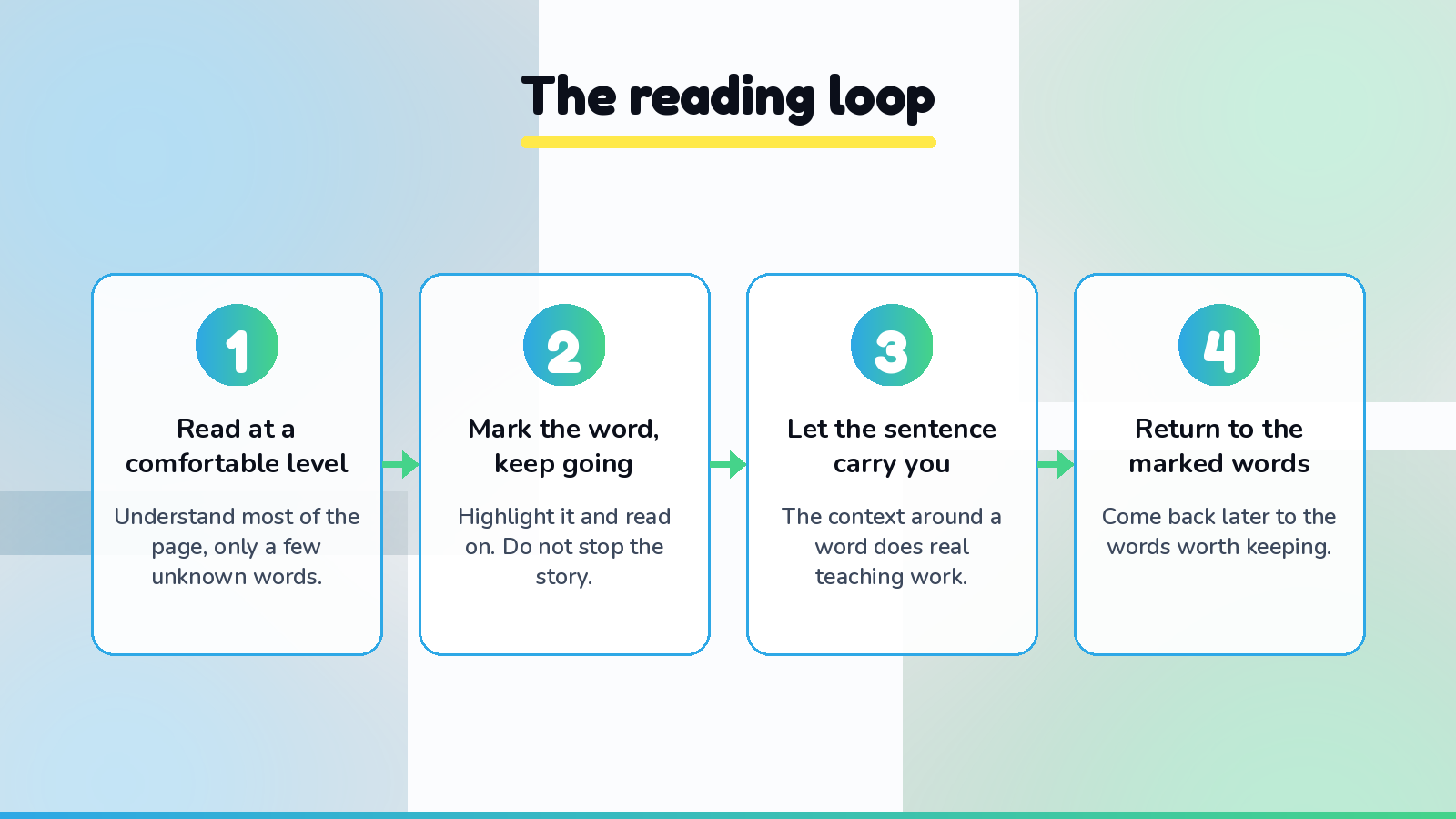
The single biggest mistake is starting too hard. If you are stopping to look up a word in every sentence, you are not reading anymore, you are decoding, and decoding is exhausting. The sweet spot is a book where you understand most of what is happening and only bump into a handful of unknown words per page. Comfortable, with a little friction.
A few reliable ways to find that level:
- Graded readers made for learners, which control vocabulary on purpose and grow with you.
- A book you already know well in your first language, so the story carries you past the words you do not know yet.
- Middle-grade or young-adult novels in Spanish, which tend to use everyday language and shorter sentences without feeling babyish.
Do not worry about prestige. A book you finish teaches you far more than a literary classic you abandon on page twenty.
Read for flow first, look up second
Once you have the right book, protect the flow. When you hit a word you do not know, resist the urge to stop and look it up right away. Most of the time the sentence around it will give you enough to keep going, and that guessing is doing real work, building the instinct you will eventually rely on to read without a dictionary at all.
The trick is to mark the word and move on, not solve it on the spot. Highlight it, underline it, or run a pen down the margin. Keep reading. The story stays alive, and you still have a record of every word worth returning to later. This is the whole idea behind extensive reading: lots of input at a comfortable level, with the friction pushed to the edges instead of the middle.
If breaking your reading flow is the part you struggle with most, we go deeper on it in our guide to remembering words from novels without breaking your reading flow.
Turn the words you marked into words you keep
Here is where most reading routines fall apart. You finish the book with a dozen pages of underlines, you fully intend to make flashcards from them, and then you look at that pile of typing and quietly never start. The reading was fun. The carding felt like a second job, so it never happened, and the words faded.
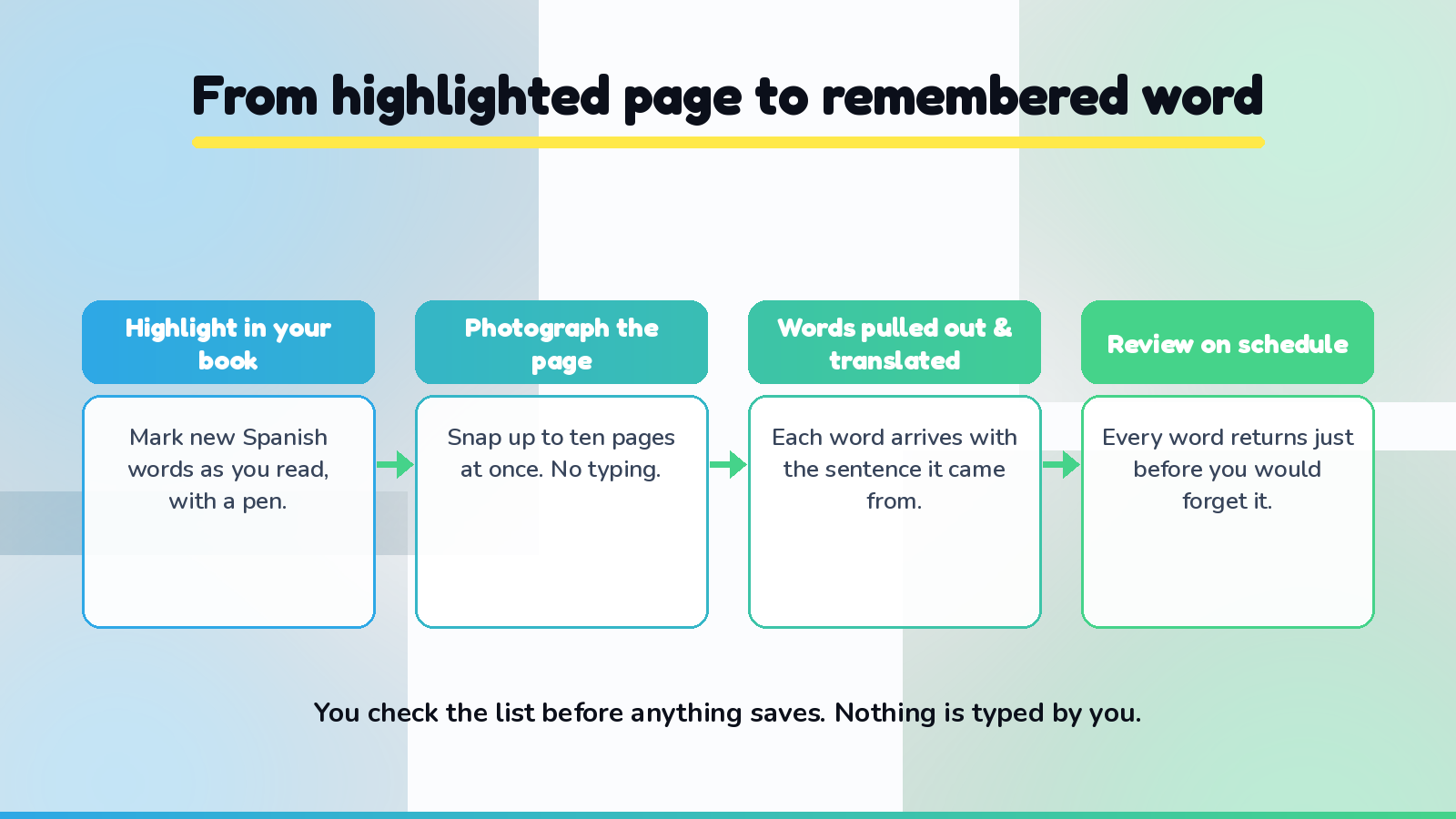
This is the exact gap Vocaboodie was built to close. Instead of typing each Spanish word and its sentence into a deck by hand, you snap a photo of the page you were reading, up to ten pages at once. The words you highlighted are pulled out along with the sentence each one appeared in, and translated, then dropped into a list you can look over before anything saves. You delete the ones you already know with a tap, keep the rest, and they slide into a review schedule that brings each word back right around the time you would otherwise forget it.
Nothing gets typed by you. The context sentence comes along for free, which matters enormously in Spanish, where the same word can shift meaning with the situation. If you would rather see how the older, manual version of this works, or want to export your words elsewhere, the full step-by-step lives in our pillar guide, how to make Anki cards from a book the fast way.
A few things that are specific to Spanish
Reading Spanish has its own small traps, and knowing them ahead of time saves a lot of confusion.
Keep the gender with the noun. When you save a new noun, save it the way you would want to recall it, ideally with its article, so "rincón" becomes "el rincón" and "madrugada" becomes "la madrugada." Gender is easiest to learn when it rides along with the word from the very first time you meet it, rather than as a fact you try to bolt on later.
Verbs will look unfamiliar in the wild. You will meet "supo," "quepo," or "durmiendo" long before it is obvious they come from "saber," "caber," and "dormir." Keeping the sentence you found the word in helps here, because it anchors the strange-looking form to a moment you actually understood, instead of a bare conjugation table.
Watch the false friends. "Éxito" means success, not exit. "Ropa" is clothing, not rope. "Embarazada" means pregnant, not embarrassed. These are the words a quick guess will get wrong, so they are exactly the ones worth marking and reviewing rather than waving past.
Notice the region. A book from Spain and a book from Argentina can use different words for the same everyday thing, different past tenses, even different pronouns. None of it is wrong, it is just worth knowing which flavor of Spanish your book is teaching you, so you are not surprised when it does not match your class.
A simple weekly routine
You do not need a complicated system. Something like this holds up for months:
- Read most days at a level that feels comfortable, marking unknown words as you go without stopping.
- Once or twice a week, photograph the pages you marked so the new words get captured with their sentences.
- Spend a few minutes on your review whenever it comes up, letting the schedule decide which words are due.
That is the entire loop. Read, capture, review, repeat. The reading stays the enjoyable part, the capturing takes minutes instead of hours, and the reviewing quietly does the remembering for you. If you want the reasoning behind why spacing your reviews out works so much better than cramming, we lay it out in how to actually remember the words you read in another language.
The takeaway
Learning Spanish by reading books works, and it is genuinely one of the most pleasant ways to do it. The only real weakness is memory, the way good words meet you on the page and then leave without a trace. Fix that one thing, by marking words as you read and capturing them without a mountain of typing, and reading stops being a leaky bucket. Every book you finish leaves you with more Spanish than the last.
Ready to keep the words from your next Spanish book instead of losing them? Start with Vocaboodie and let a photo do the typing.