Reading Streaks: Why a Little Chain of Days Keeps You Going
Most people do not quit reading in a new language because it is too hard. They quit because they lose the thread. A few good days, then a busy week, then a month where the book sits face down on the nightstand, and by the time they pick it up again they have forgotten where they were and half of what they had learned. The hard part was never any single day of reading. It was stringing enough of those days together to build something.
A reading streak is a small tool built for exactly that problem. It is nothing more than a count of the days in a row you have shown up, but that little number does something surprisingly large to how it feels to keep going. This post is about why streaks work, what makes a good one, and how to let a streak help you without letting it boss you around.
What a streak actually is
Strip away the flames and the badges and a streak is just an honest record of showing up. You read today, the count goes up by one. You read tomorrow, it goes up again. Miss a day and the chain breaks, and you start rebuilding from one. That is the whole mechanism.
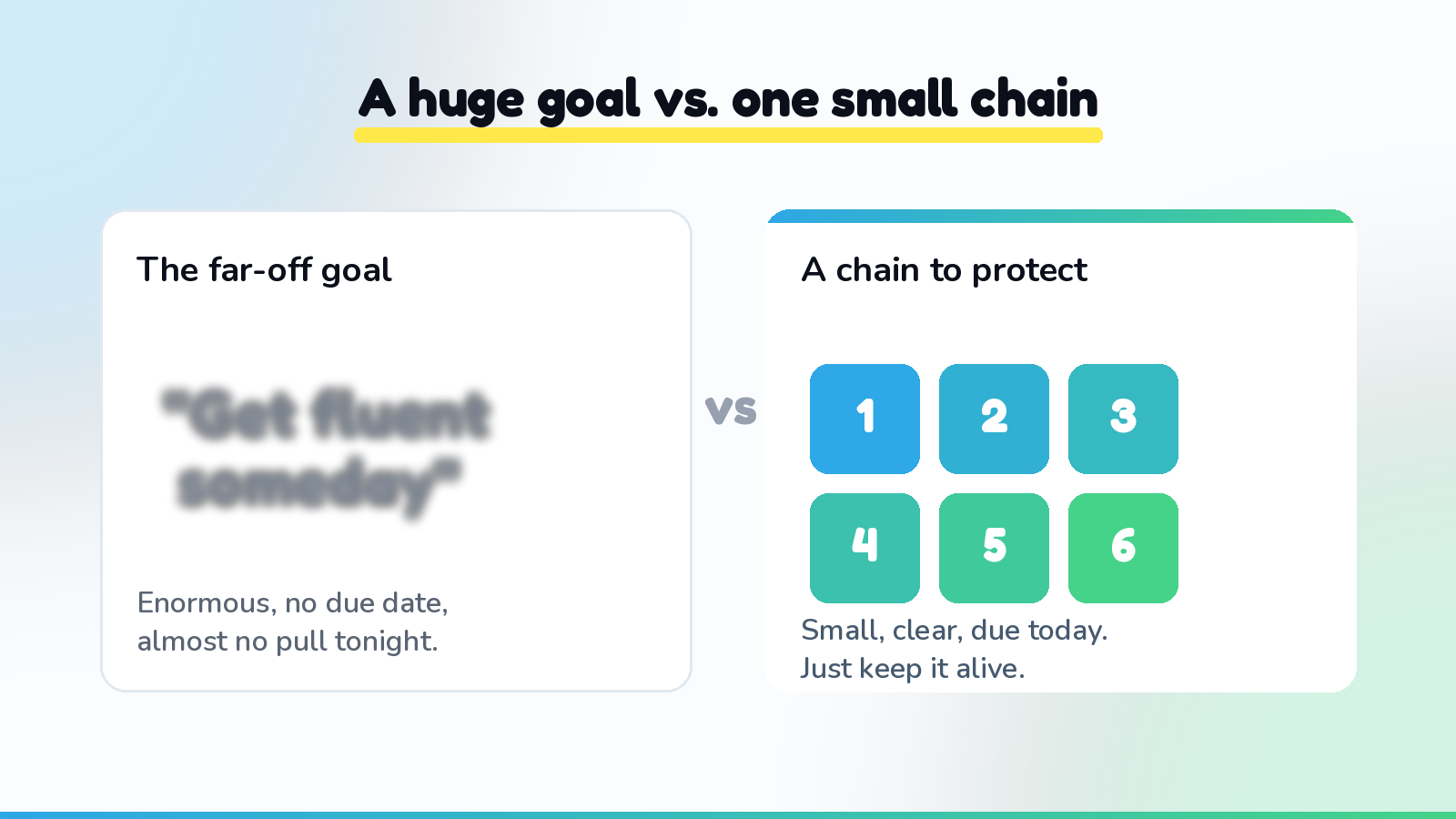
The reason it works is that it turns a fuzzy, faraway goal into a concrete thing you can protect. "Get good at Spanish" is enormous and has no finish line, so on any given Tuesday it exerts almost no pull. "Do not break my nine-day chain" is small, clear, and due today. You are no longer trying to summon motivation for an abstract future self. You are just keeping a number alive, and that is a task small enough to actually do.
Why the chain pulls on the mind
There is a simple psychology under all of this, and it is worth understanding because it tells you how to use a streak well.
The first thing is momentum. Once you have a chain of any length, breaking it feels like a small loss, and people work harder to avoid losing something they have than to gain something they do not. A three-day streak is already worth protecting. A thirty-day one feels almost precious. The longer it grows, the more the streak quietly argues on behalf of the reading.
The second thing is that a streak lowers the size of the decision. Without one, every night you are deciding whether to study, which is a heavy question when you are tired. With a streak, the decision is smaller: just keep the chain alive, even a little. That is why the best streaks reward showing up rather than grinding. Ten minutes with your book counts. The point is to make the daily yes cheap enough that you almost always say it.
The third thing is that it makes progress visible on days when progress feels invisible. Learning a language from books is slow in a way that hides its own results. You cannot feel your vocabulary growing word by word, so it is easy to believe nothing is happening. A streak, and the small pile of stats around it, gives you something to look at that says otherwise. You may not feel smarter tonight, but the number does not lie: you have shown up eleven days running, and all eleven of those days are still working inside you.
Streaks and remembering are the same habit
Here is where a reading streak becomes more than a motivational trick. Consistency is not only good for morale. It is the exact thing that memory needs.
Words stick when you meet them again at spaced-out intervals rather than cramming them once and hoping. That is the whole idea behind a smart review schedule, which brings a word back just as it is about to slip away, and we walk through it plainly in spaced repetition for people who learn by reading. The catch is that this kind of review only works if you actually turn up on the days it asks for. A review that is due today and skipped is a word quietly forgotten.
So a streak and a review schedule are two views of the same habit. The streak gives you a reason to open the app tonight. The review schedule makes sure that when you do, the minutes go to the words most in danger of fading. One supplies the motivation, the other supplies the payoff, and together they turn "I read most days" into "I am steadily keeping the words I meet."
Where the words come from matters too
A streak of empty days is not worth much. What makes the chain valuable is that each day adds something real, and for a reader that something is the words you meet in your books. This only works if capturing those words is fast enough that it never threatens the streak itself.
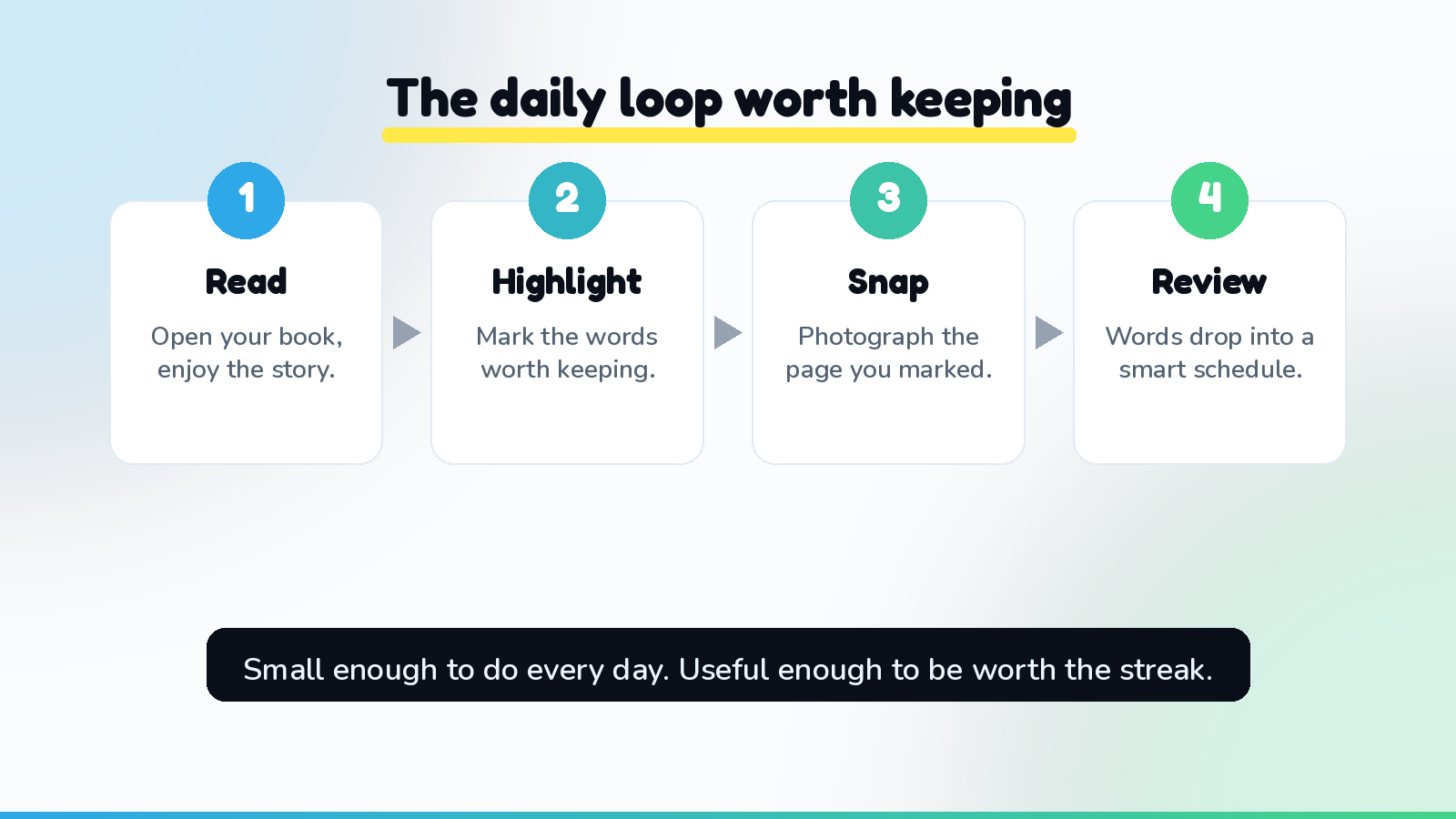
With Vocaboodie the daily loop is light on purpose. You read, you highlight the words worth keeping, and you snap a photo of the page. The highlighted words are pulled out, translated, and given the sentence they appeared in, then dropped into your review schedule automatically. There is no evening of typing cards, which is exactly the chore that used to break reading habits. If you want to see that capture step on its own, how to remember words from novels without breaking your reading flow shows how to mark words as you go, and how to make Anki cards from a book the fast way is the full walkthrough of turning a page into finished cards.
The reason this matters for streaks is friction. A habit survives when the daily cost is tiny. Make the capture painless and the streak protects a genuinely useful behavior instead of just rewarding you for opening an app.
Shareable stats, without the pressure
Numbers are more fun when you can show them off a little. A run of days, a count of words gathered this month, the books you have worked through: these are the kind of small, honest stats that feel good to glance at and, now and then, to share with a friend who is learning too. A little visible progress is a real motivator, and a gentle nudge from someone else chasing their own streak can be the thing that gets you to read on a night you might have skipped.
The trick is to keep the stats a mirror, not a whip. They are there to show you that you are moving, not to make you feel bad on the days you are not.
How to keep a streak without it keeping you
Streaks turn sour when they stop serving you and start stressing you. A few small rules keep them healthy.
Make the daily minimum tiny. Define your streak as ten honest minutes, not a chapter, so a hard day still counts and the chain survives. Protect the habit, not the perfection. If you miss a day, the useful move is to start again at one, tonight, rather than deciding the run is ruined and walking away for a month. And remember that the streak is a means, not the goal. The goal is a head full of words from books you loved. The streak is just the friendly little machine that keeps you coming back until those words are yours.
Want a chain worth keeping? Start with Vocaboodie, read a little every day, and watch both your streak and your pile of remembered words grow together.