Where Vocabulary Practice Fits in a Comprehensible Input Routine
The comprehensible input idea is simple and a little bit magical. Give your brain a steady diet of language you mostly understand, and the language grows on its own. No grammar drills, no vocabulary lists, just hours of reading and listening to things that make sense to you. If you have spent any time in the Refold or Dreaming Spanish world, you know the feeling. It works. Words you never sat down and studied start to feel obvious, and one day you realize you understood a whole scene without translating a thing.
So here is a fair question, and one that starts a lot of arguments online. If input does the heavy lifting, is there any reason to touch vocabulary directly at all? Is a review habit just the old flashcard grind sneaking back in through the side door? This guide is an honest answer from someone firmly on the input side of the fence. Input really is the engine. But there is one narrow place it runs slow, and a very light capture habit patches it without turning your immersion into a chore.
What input gets right, and why you should not fight it
Start by giving comprehensible input its due, because it earns it. When you meet a word again and again inside stories you follow, you do not just learn its dictionary meaning. You learn its texture. You learn that this word is a bit formal, that one is what a character says when they are annoyed, this other one always seems to show up around food. That web of feeling is almost impossible to build from a flashcard that shows a word and a single gloss. Input builds it for free, quietly, in the background.
This is why the input crowd is right to be suspicious of heavy vocabulary study. If you spend your language hour drilling isolated words, you are trading away the very thing that makes those words stick, which is meeting them in context, many times, while your attention is really on the story. No amount of card-flipping matches an afternoon lost in a good book. So the goal is not to replace input with study. The goal is to protect your input time and let it stay the main event.
The one place input runs slow
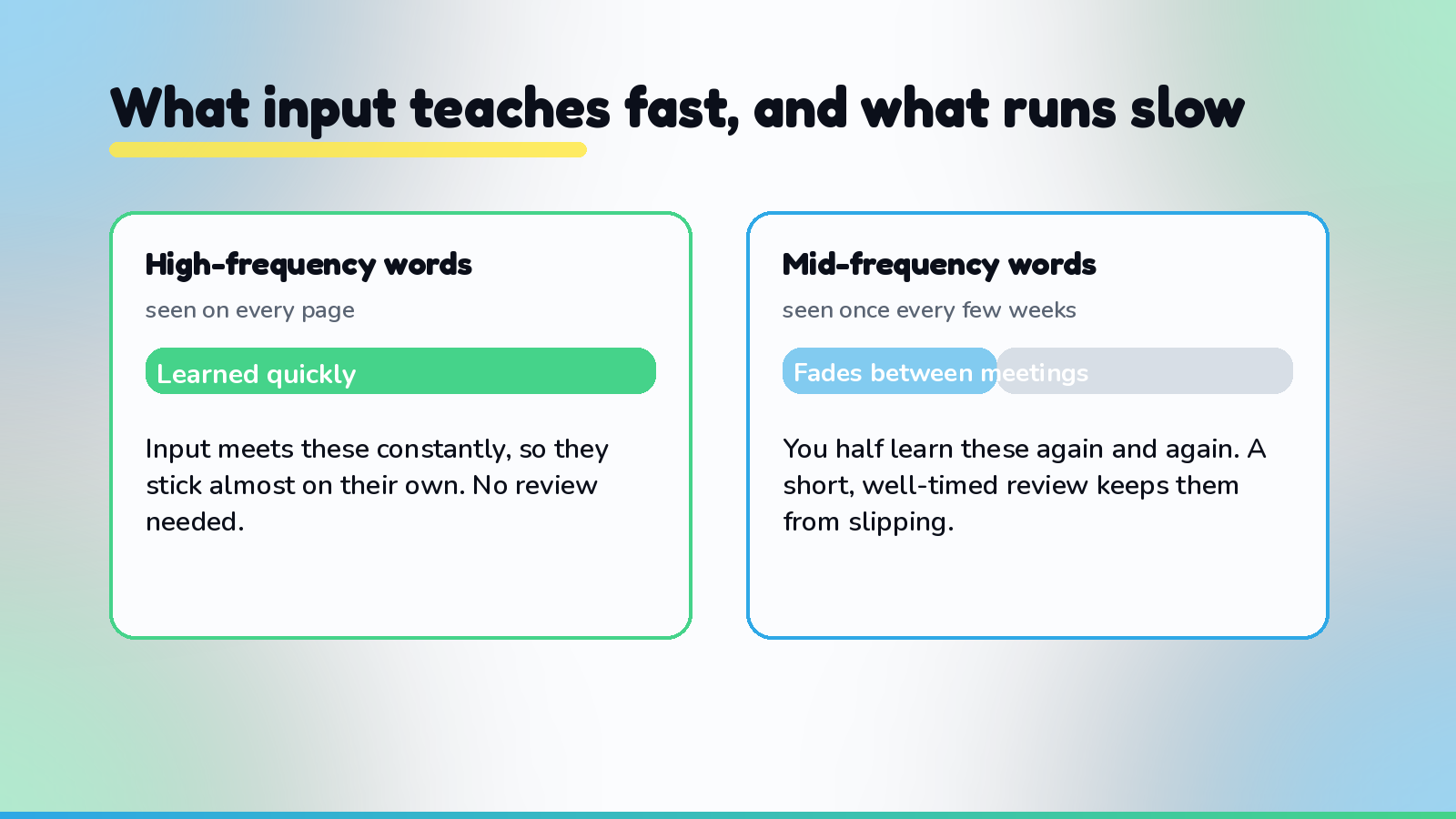
Here is the honest catch. Input teaches high-frequency words beautifully, because you meet them constantly. The word that appears on every page gets learned whether you like it or not. But the mid-frequency words, the ones that show up once every thirty or forty pages, are a different story. You meet "smolder" or "grudging" or "eaves," half understand it from context, and then do not see it again for two weeks. By the time it comes back, the faint memory has already faded, so you half learn it a second time, and a third, and the word just hangs there in the fog for months.
That slow lane is real, and it is the honest limit of pure input. You will get there eventually, because enough exposures will do it, but "eventually" can mean a very long time for words you genuinely want now. This is the exact gap a small review habit fills, and why we wrote a whole plain-English explainer on spaced repetition for people who learn by reading. A short, well-timed nudge on those mid-frequency words does not replace the input that taught you their meaning. It just stops the ones you have already met from slipping away before input can cement them.
A capture habit, not a study program
The word "study" is what scares input people off, and rightly so. So let us be precise about what we are actually adding. It is not a course. It is not a daily deck you dread. It is a capture habit, and it should cost you a couple of minutes, not an evening.
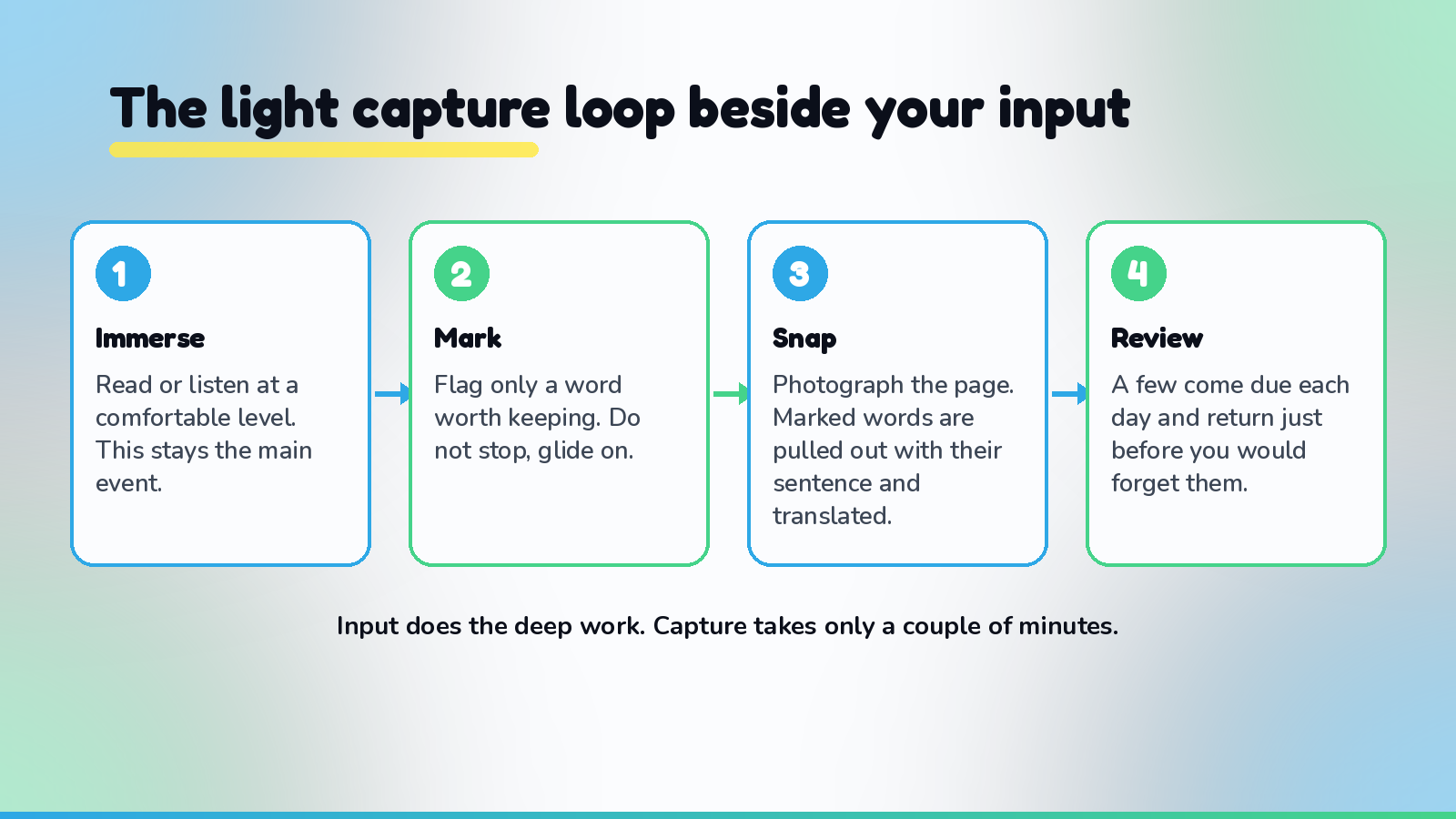
The habit is this. While you read or watch, do not stop to look words up and do not break your flow. When something catches your eye, a word you have half met before and would genuinely like to own, you just mark it and glide on. That is the whole discipline while you are immersing. We go deeper on that no-stopping instinct in our guide to remembering words from novels without breaking your reading flow, and it matters just as much for input purists as for anyone else. Your immersion stays unbroken. The only thing you have added is a quiet record of the handful of words worth a second look.
Then, later, well outside your input time, you turn those marked words into gentle review. And this is the step that has always been the problem, because building the review by hand is slow and joyless enough that most people simply never do it.
Fitting capture into a real input routine
This is where the tooling matters, because the friction is what kills the habit. Vocaboodie is built to make the capture step almost disappear, which is exactly what an input-first learner needs. Instead of typing each word and its sentence into a deck, you snap a photo of the page you were reading, up to ten pages at once. The words you highlighted are pulled out along with the full sentence each one lived in, and translated, then dropped into a list you can look over before anything is saved. You tap away the ones you already know from all that input, keep the few that are genuinely still fuzzy, and they slide into a review schedule that brings each word back right around the time you would otherwise forget it.
Notice how well that fits the input philosophy rather than fighting it. The sentence comes along for free, so you are never reviewing a bare word stripped of its context. You review it inside the very sentence where you met it, which keeps the whole thing rooted in real language instead of a dictionary. And because the capture takes seconds, it never competes with your reading and listening hours. If you want to see the older, hand-built version of this workflow, or you want to export your words to use elsewhere, the full walkthrough lives in our pillar guide, how to make Anki cards from a book the fast way.
Rules of thumb so review never takes over
If you are going to add a review habit to an input routine, a few guardrails keep it from quietly turning into the thing you swore off:
- Keep input the main event. If review ever starts eating the time you would spend reading or listening, cut the review, not the input.
- Only capture words you have already met and half know. Brand new words are input's job. Review is for the ones on the edge of sticking.
- Be ruthless when you tap away words. If a word already feels easy from all your immersion, let it go. The list is for the stubborn few, not everything you did not instantly recognize.
- Review inside the sentence, never the bare word. The context is what makes the memory land, so keep it.
Done this way, review is not a rival to comprehensible input. It is a small helper riding alongside it. The reasoning behind why input remains the thing that actually teaches meaning is worth sitting with too, and we cover it from the reader's angle in how to actually remember the words you read in another language.
The takeaway
Comprehensible input is not wrong, and you do not need to bolt a heavy study program onto it to succeed. Input will teach you the vast majority of your vocabulary on its own, in context, with all the texture a flashcard can never capture. The only real weak spot is the mid-frequency word that fades between meetings, and the fix for that is small: mark the few words worth keeping while you immerse, capture them in a couple of minutes with a photo instead of an hour of typing, and let a gentle schedule return them before they slip. Keep input in the driver's seat, add the lightest possible capture habit beside it, and you get the best of both. Hours of real language doing the deep work, with a quiet safety net under the words that would otherwise get away.
Ready to keep the words your immersion almost taught you? Start with Vocaboodie and let a photo do the typing.