Every language learner eventually has this argument with themselves in a bookshop. The paperback in your hand is beautiful and slightly terrifying. The e-reader in your bag has a built in dictionary and would let you look up every single word on that page without moving.
The honest answer is that neither format teaches you vocabulary. What teaches you vocabulary is what happens to a word in the days after you meet it. Format matters only because it changes how easy it is to catch a word in the first place, and how much of the sentence around it survives the journey.
So let us compare the two on the thing that actually decides it: the capture loop.
What each format is genuinely good at
An e-reader is good at removal of effort. Tap a word, the meaning appears, tap away, keep reading. The book is weightless, the light is adjustable, and you can buy a novel in Spanish at eleven at night without leaving the sofa. For learners whose target language is hard to find in local bookshops, that last point alone can settle the argument.
Paper is good at friction in the right places. You cannot tap a word on a paperback, so you either work the meaning out from context or you mark it and move on. Both of those are useful. Paper also gives you something screens are strangely bad at: a stable sense of place. Readers routinely remember that a word was on the left page, a third of the way down, near the bit where the argument started. That spatial memory is real, and it quietly helps recall.
Neither of those is a small advantage. They just point in opposite directions.
The e-reader capture loop, honestly
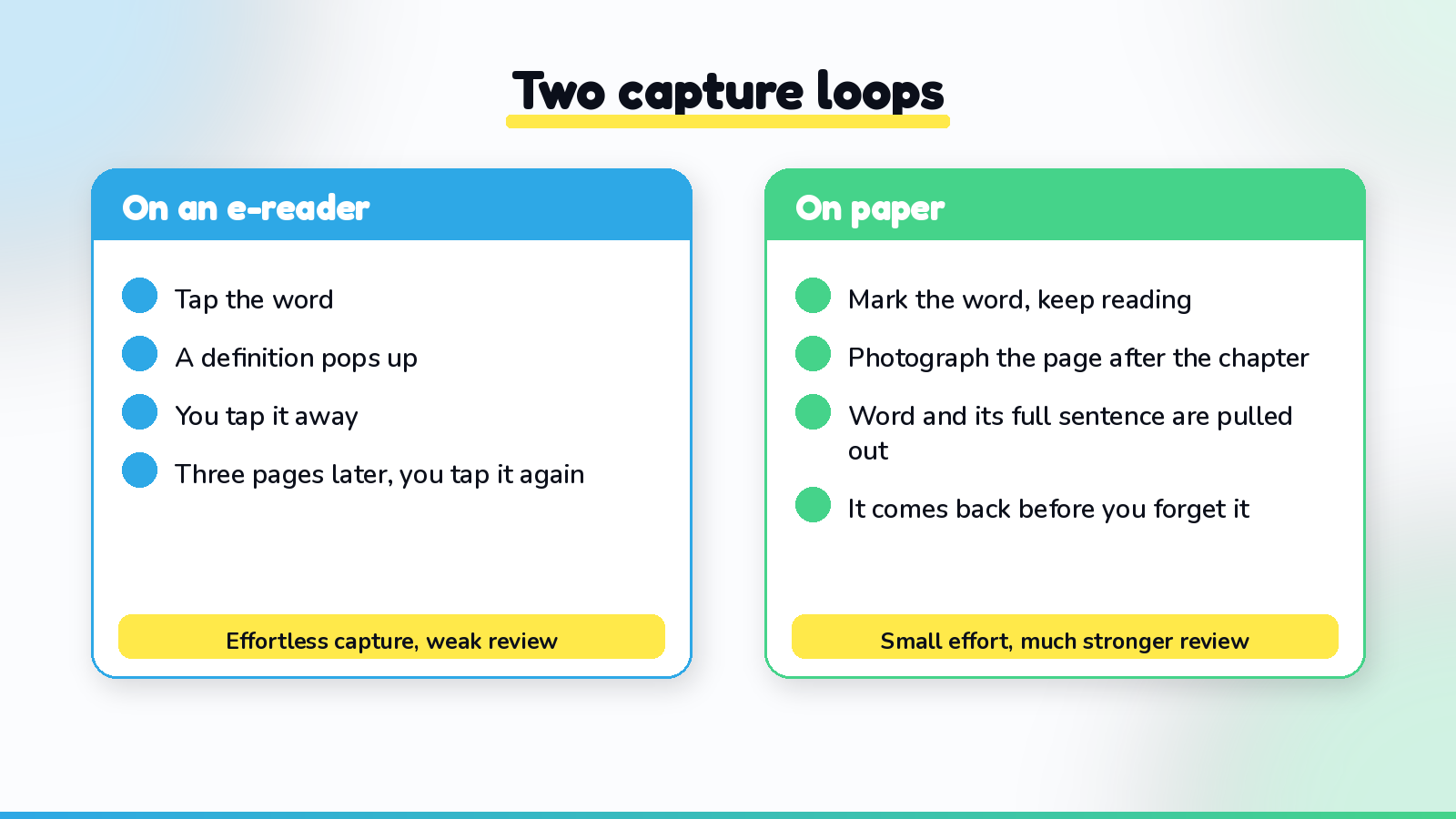
Here is what usually happens. You tap an unfamiliar word. A definition slides up. You read it, you nod, you tap it away. You feel like you have learned something.
Three pages later you meet the same word and tap it again.
This is not a failure of discipline. Tapping is so cheap that it never becomes a decision, and a lookup you did not have to work for is a lookup your brain files under "handled" rather than "learn this". Most e-readers do keep a list of the words you tapped, and some have a vocabulary builder that will show them back to you. But the words tend to come back stripped down: the term, a dictionary gloss, and often a single line of surrounding text that may or may not be the useful part of the sentence. Getting that list back out of the device, into a form you can actually review, is where most people quietly give up.
So the e-reader loop is: effortless capture, weak review.
The paper capture loop, honestly
On paper you have a pencil, a highlighter, or a folded corner. You mark the word and you keep reading, because stopping to type it into a notes app is exactly the interruption that ends reading sessions. We have written before about why protecting that flow matters more than people expect in how to remember words from novels.
Then, at the end of a chapter, you have a page with four or five marked words on it and a decision to make. Historically that decision was grim: copy each word into a notebook or a card by hand, with its sentence, its translation, and a reason to remember it. That is a minute or two per word, which is why so many notebooks stop halfway down page three.
The shortcut is to photograph the marked page instead. One snap holds every marked word plus the full sentence it lived in, which is the part that makes a word memorable later. Vocaboodie was built around exactly that step: snap the page, the highlighted words are pulled out and translated with their sentence attached, and they drop into a review schedule that brings each one back just before you would have forgotten it. If you want the mechanics, turning a photo of a page into flashcards walks through it.
So the paper loop is: slightly effortful capture, much stronger review.
Head to head
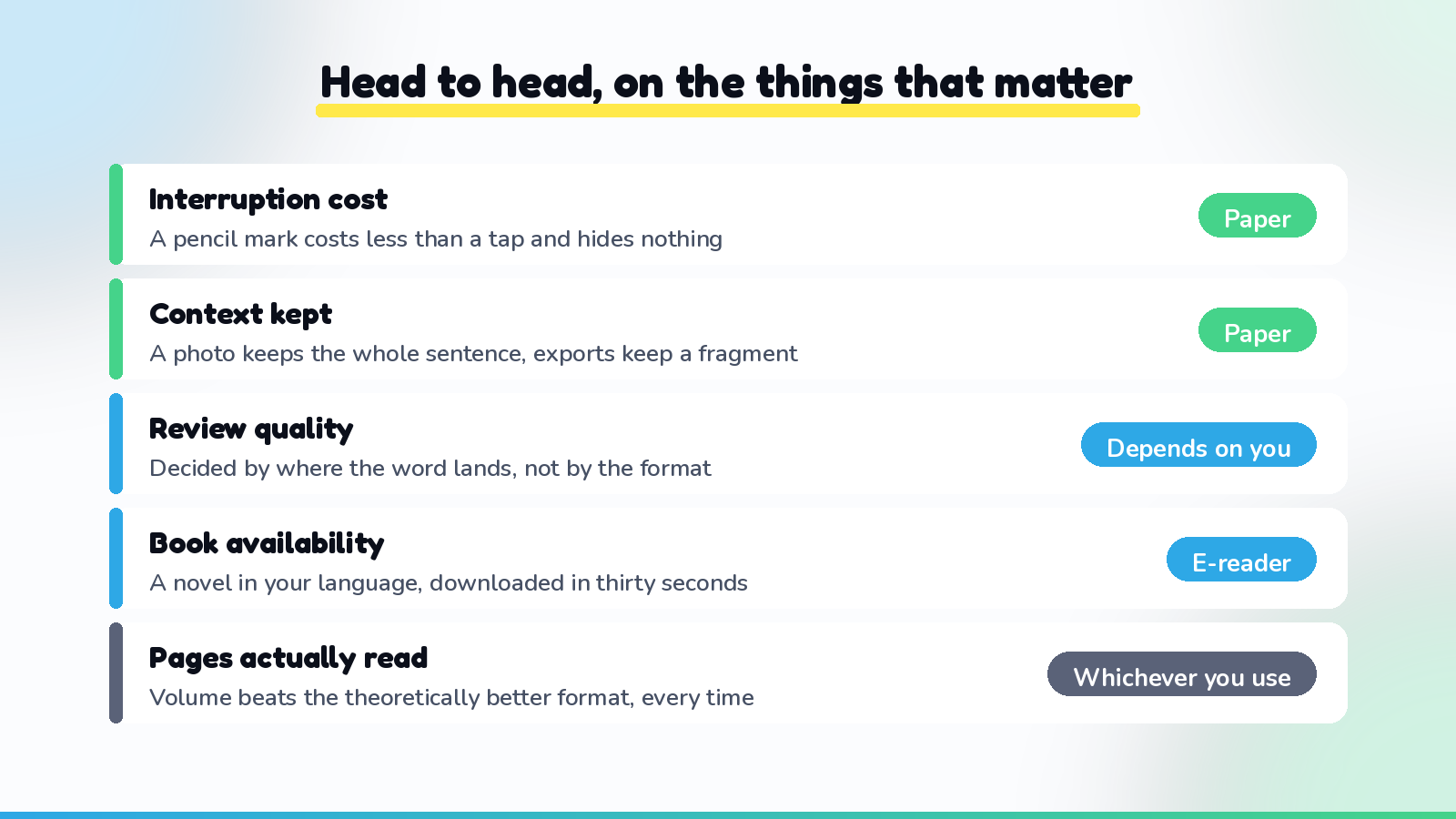
Interruption cost. E-reader wins on the surface, since a tap costs about a second. Paper wins in practice for a lot of readers, because a mark costs even less than a tap and does not put a definition box between you and the story.
Context kept. Paper wins clearly. A photo of the page keeps the whole sentence, the paragraph, and the scene. E-reader exports usually keep the word and a fragment. A word without its sentence is much harder to recall a week later, and much easier to misremember.
Review quality. This depends entirely on where the words end up, not on the format. A tapped word that sits unreviewed in a device list is worth roughly nothing. A marked word that reaches a proper review schedule is worth a lot. Paper has the shorter path to the second outcome right now.
Availability. E-reader wins, sometimes decisively. If you are learning a language whose books are hard to buy where you live, a device that can download a novel in thirty seconds beats every argument above.
Choosing the right book. A draw, but worth naming: sample chapters are easier to get on a device, which makes the two minute page test from choosing a book at the right level a bit quicker to run before you commit.
So which should you read on
Read on whichever one you will actually read on. That is not a dodge, it is the whole point. Volume of pages read is the single biggest driver of vocabulary growth, and the format that gets you to fifty pages a week beats the format that is theoretically better and sits on the shelf.
What you should not do is let the format decide whether words get reviewed. Both formats can feed one pile.
- On paper: mark as you read, photograph the page at the end of the chapter, review the words that come back.
- On an e-reader: keep tapping, but treat the tap as a mark rather than a lesson. At the end of a session, add the three or four words that mattered into your review pile with the sentence you met them in. Three or four, not thirty.
That second rule is the one people skip. E-readers make it possible to collect ninety words in an evening, and ninety words is how a review pile becomes something you avoid. If your pile is already there, reviewing vocabulary without burning out covers the way back.
The mixed setup most readers land on
After a few months, a lot of readers end up doing this without planning it. Paper for the book they are serious about, because marking is quick and the photo step turns a chapter into a handful of well formed cards. A device for travel, for late nights, and for languages where paper is hard to find. One review pile for both, so the words meet again regardless of where they came from.
Tools that can hold that pile, with Vocaboodie first because it is built for the photo step: Vocaboodie, then Anki if you enjoy building your own cards, then LingQ or Readlang if most of your reading is already on a screen. Any of them work. What matters is that there is only one of them.
Try this over the next week
- Pick one book and one format. Do not switch mid book.
- Mark or tap freely while reading, but never stop to type.
- At the end of each chapter, capture at most five words, with their sentences.
- Give the pile ten minutes before you next open the book.
Do that for a week and you will notice something. The words that come back are not the exotic ones you were proud of catching. They are the ordinary mid frequency words that kept turning up, which are exactly the ones that make the next book easier. If you want the full version of that workflow, start with making cards from a book the fast way.
The paperback and the e-reader were never really in competition. The competition was always between a word that got captured and a word that did not.