How to Review Vocabulary Without Burning Out
Most people do not quit language learning because the language is hard. They quit because of a number.
The number sits at the top of a review screen, and one day it says 214. You look at it, you do the arithmetic, you realise it is forty minutes of work before you are allowed to read a single page of the book you actually wanted to read, and you close the app. Tomorrow it says 260.
That is burnout in its most ordinary form. Not drama, just quiet avoidance of a task that got too big. And it is worth saying clearly: when this happens, it is almost never a discipline problem. It is a design problem. The pile grew because of decisions made weeks earlier, and it can be shrunk by changing those same decisions.
Here is how the pile gets big, and what to do about it.
Why the pile grows faster than you expect
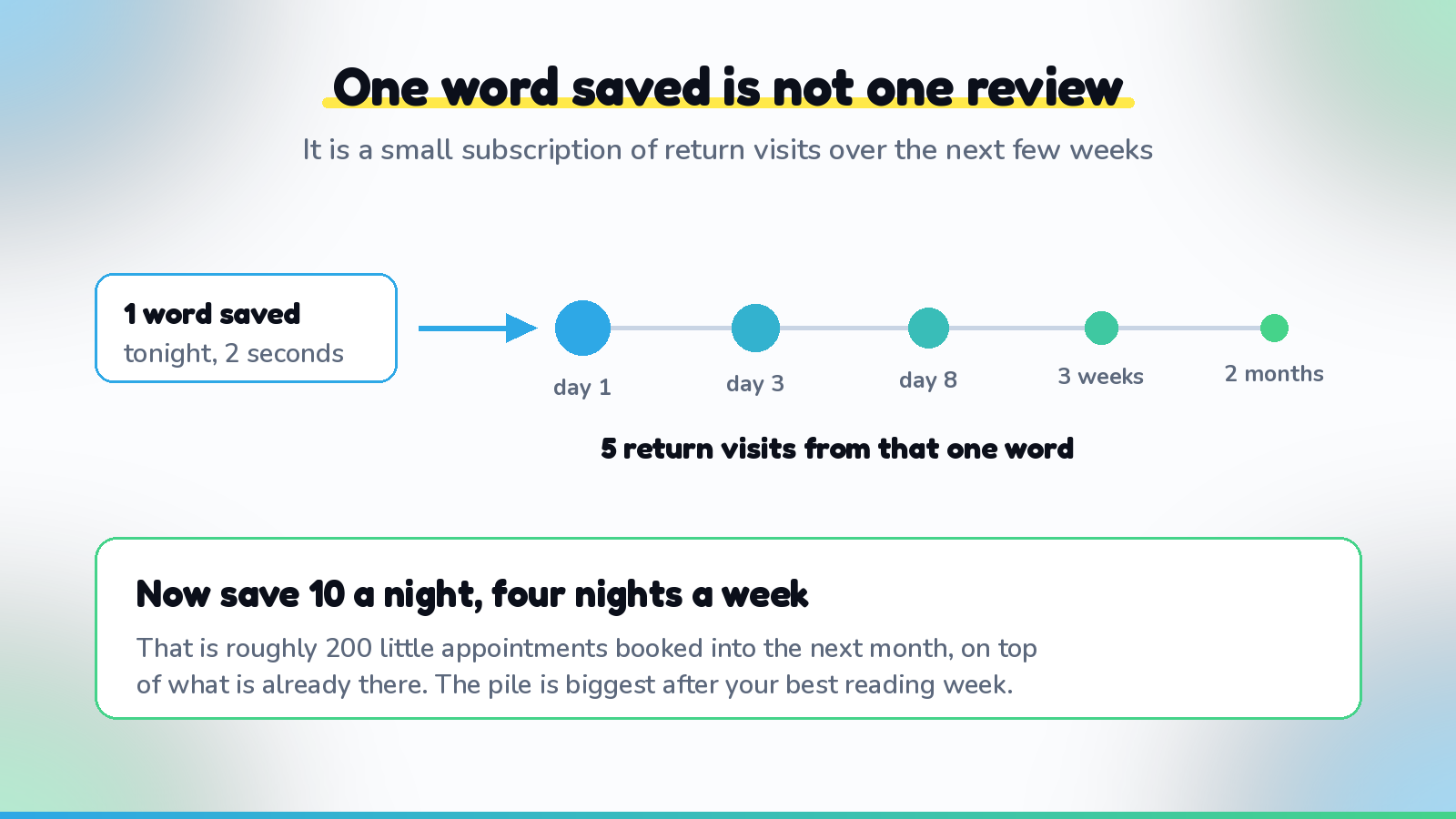
Every word you save today comes back to you several times over the following months. That is the point of reviewing, and it works. But it means each new word is not a one-off cost. It is a small subscription.
Save ten words on a good reading evening and you have not added ten minutes of future work. You have added ten little recurring appointments, most of them landing in the next three weeks. Do that four evenings a week for a month and the arithmetic gets away from you fast. New words arrive at whatever rate you choose, while old words keep coming back on their own schedule, and the two streams pile up on the same screen.
The frustrating part is that the pile is biggest exactly when your reading is going well. You find a book you love, you read three chapters in one sitting, you save thirty words because they were all interesting, and you have just written a cheque that next week has to cash.
Rule one: cap the new words, not the reviews
The single most effective change is also the least intuitive. Do not try to review faster. Limit how many new words you let in per day.
Reviews of words you already saved are not really optional. Skip them and the words fade, which wastes the effort you already spent. New words, on the other hand, are completely under your control. They are the tap, and the reviews are the water level.
A sensible cap for most readers is five to ten new words a day. Ten feels stingy on a night when you met forty interesting words. It will not feel stingy in three weeks, when your daily review takes eight minutes and you still have an hour of reading time left.
If you are reading a lot, you will meet more words than your cap allows. That is fine, and it is not a loss. Keep reading, save the ones worth saving, and let them queue up to be introduced a few at a time. A word waiting quietly to be learned costs you nothing. A word introduced too early, alongside thirty others, is the one you will fail four times and grow to resent.
Rule two: be much pickier about what you save
The second lever is what earns a place in the pile at all.
Not every unknown word deserves to be reviewed. A word is worth saving when it is likely to come back: a common verb, a connector, a word you have now met twice in the same book. A word is usually not worth saving when it is scenery. The specific name of a nineteenth century carriage, a regional insult, a technical term from a single chapter about sailing. You understood it in context, the story moved on, and you will not meet it again for years.
A quick filter that works well: would you be pleased or annoyed to see this word tomorrow morning? If the honest answer is annoyed, do not save it.
Being picky feels like leaving value on the table. In practice it does the opposite. Twenty well-chosen words that you actually review beat two hundred words you avoid.
Rule three: give reviewing a fixed slot and a fixed size
Open-ended tasks are the ones we postpone. "Do my reviews" has no visible end, so the brain treats it as a chore of unknown size.
Two small structural fixes help more than they sound like they should.
Attach reviewing to something you already do. Before you open your book, not after. The pre-reading slot works well because reviewing then acts as a warm-up rather than a toll you pay at the end of a tiring day, and because the reward, your book, is right there.
Then give it a size. Ten minutes, or one pass, and when the timer goes you stop. The words you did not reach will come back tomorrow. Nothing breaks. What matters far more than finishing today''s pile is that you show up again tomorrow, which is the same reason a small daily reading habit outperforms an ambitious weekend one. We wrote about that effect in reading streaks and why they work.
When you already have a backlog
Say the number is 400 and you have been avoiding it for two weeks. Two ways out, and only one of them works.
The way that does not work is deciding to clear it in one heroic session. You will grind through 400 cards in an hour, remember almost nothing, and be so put off that you will not come back for a month.
The way that works is less satisfying and much faster in practice:
- Stop new words entirely for one to two weeks. Set new cards to zero. Keep reading, keep saving words for later, just do not introduce them yet. This alone stops the pile growing.
- Do a fixed slice a day. Thirty cards, or ten minutes. Not the whole pile. Same slice, every day.
- Delete without guilt. Go through the backlog once and remove anything you no longer recognise as useful. Words you saved on holiday, duplicates, scenery. Cutting a backlog by a third is normal and costs you nothing real, because a word you would never review is not an asset.
- Turn new words back on slowly. When the pile is manageable again, come back at five a day, not twenty.
Most 400-card backlogs are gone in two weeks with this. The important part is step one. You cannot bail out a boat while the tap is still running.
Where the tools fit
None of this requires an app. It is a set of decisions, and you can make them with paper.
What a tool should do is make the good decisions the easy ones. Timing the return visits so you are reminded just as a word is starting to fade, rather than reviewing everything every day. Making a word cheap to capture so being picky is a choice rather than a chore. Letting you cap new words so a great reading night does not become next week''s problem.
That is the shape we built Vocaboodie around. You snap a photo of the page you highlighted, the marked words are pulled out and translated with the sentence they came from, and they drop into a smart review schedule that brings them back at widening intervals. Because saving a word costs a couple of seconds rather than a minute of typing, you can afford to be selective about which ones you keep, and the pile stays a size you will actually face. Other tools handle this differently, and we compared a few of them honestly in the best apps to learn languages by reading.
The short version
The review pile is not a test of character. It is a tap and a bucket, and you control the tap.
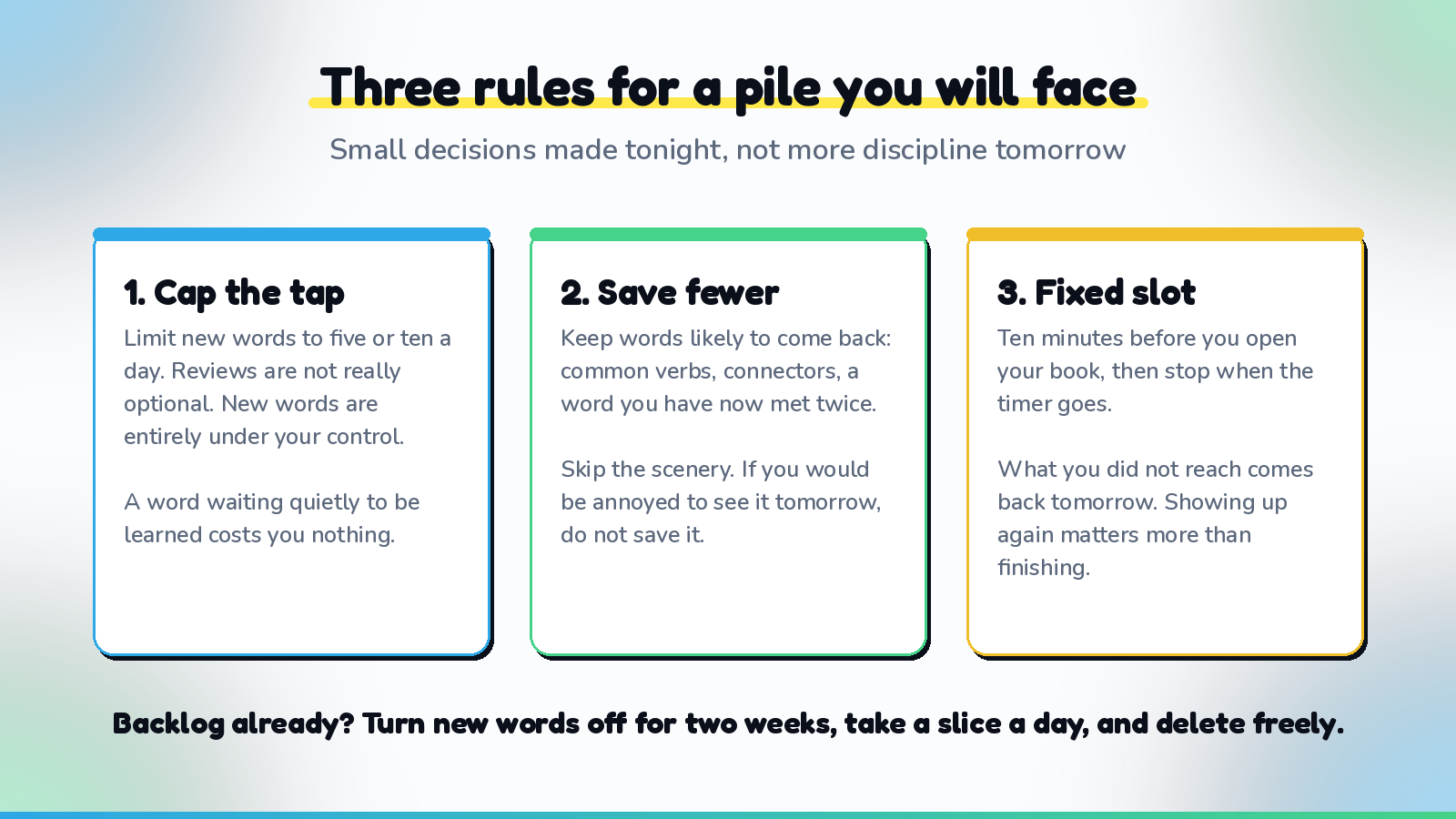
Cap new words at five to ten a day. Save fewer, better words. Review for ten fixed minutes before you read, and stop when the time is up. If you already have a backlog, turn the tap off, take a slice a day, and delete freely.
Do that and reviewing becomes the small thing it should always have been: a few minutes that make the book you are about to open a little easier than it was yesterday. If you want the reasoning behind why those widening gaps work at all, spaced repetition for people who learn by reading covers it in plain English, and if you are still building the capture habit itself, start with how to remember words from novels.