How to Build Vocabulary Reading in European Portuguese
If you are learning European Portuguese, you have probably noticed a strange problem before you even open a book. Most of the Portuguese in the world, in songs, on video, in the apps, is Brazilian. It is lovely, but it is not the Portuguese spoken in Lisbon or Porto, and if you are aiming for Portugal, all that input can quietly pull you the other way. Reading is the cleanest way out of that. When you pick a book published in Portugal, by a Portuguese author, you decide exactly which Portuguese lands in your head. The page is where you get to choose.
There is a second reason the page matters so much here. Spoken European Portuguese is famously compressed. Unstressed vowels get swallowed, syllables vanish, and whole words arrive at your ear sounding like a soft rush of consonants. On the page that same word stands still, with every letter present, long enough for you to actually learn it. Reading is not just a nice extra for European Portuguese. For a lot of the vocabulary, it is where the word finally holds its shape.
The catch is the one every reader knows. You get a few chapters in, the story starts to pull, and the new words wash past you. It feels wonderful. Then a week later you meet the same word again and still cannot say what it means. This guide is about closing that gap without turning your reading into homework.
Choose your Portuguese by choosing your book
Before anything else, make sure the book itself is European Portuguese. This is the one decision that separates learning Portuguese-from-Portugal from slowly drifting into Brazilian without noticing. A book written and published in Portugal will give you the vocabulary, spelling, and rhythm you are actually after.
You have wonderful options at every level. For a gentler start there are graded readers made for learners and books written for younger Portuguese readers, which use everyday language without feeling flat. When you are ready for the real thing, contemporary authors like Afonso Cruz, Dulce Maria Cardoso, and valter hugo mãe write in living, modern European Portuguese, and the classics of Eça de Queirós, Sophia de Mello Breyner Andresen, and José Saramago are waiting when you want them. If you reach for a translation of a book you already love, just check that it is a Portuguese edition rather than a Brazilian one.
Pick a level a notch below your ambition. If you are looking something up in every sentence you are not reading, you are decoding, and decoding wears you out by chapter two. Aim for a book you can nearly read on your own, tripping over only a few unfamiliar words per page. A light novel you finish will teach you far more European Portuguese than a masterpiece you abandon.
Do not stop. Mark the word and glide on
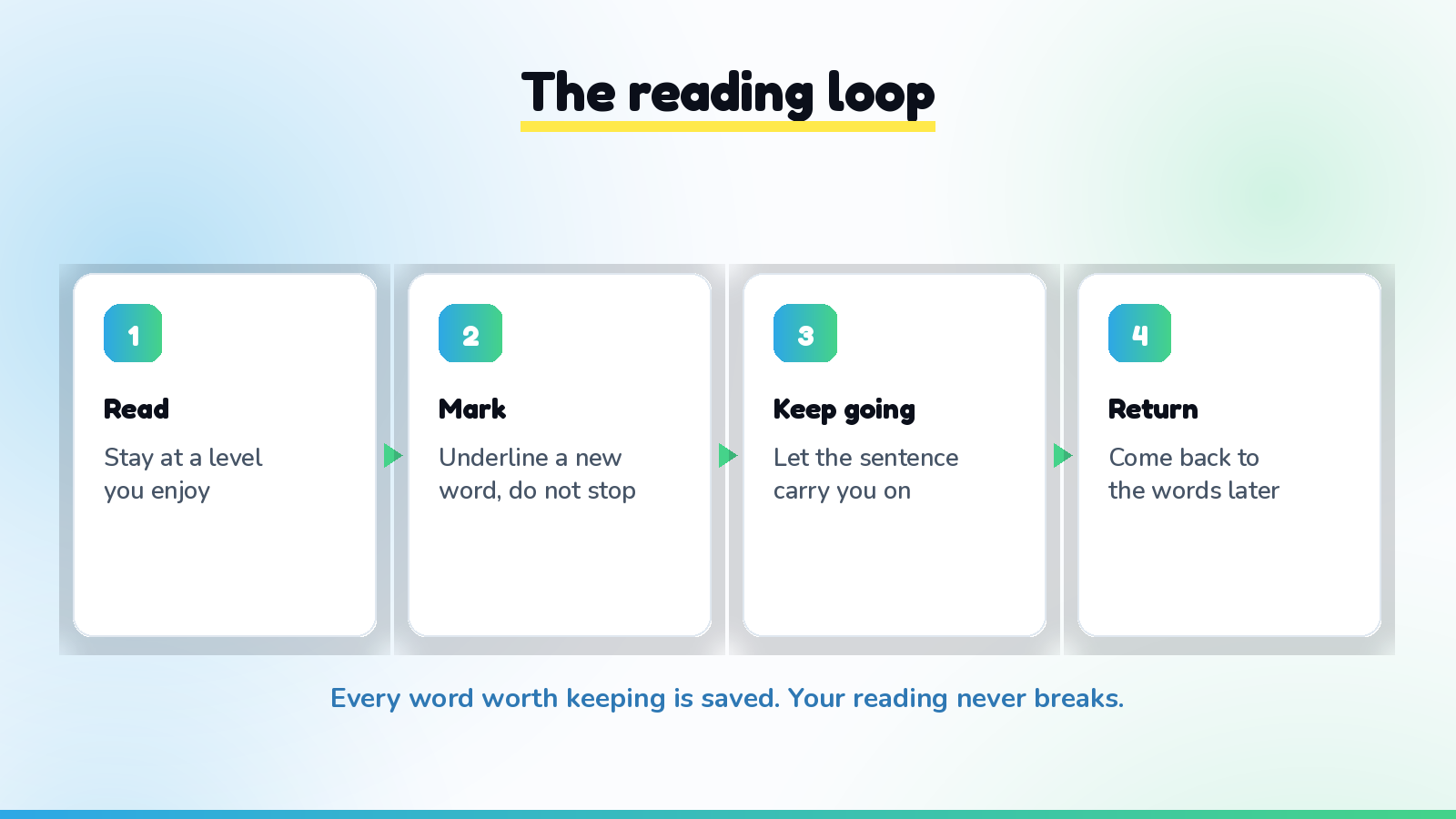
Once the book fits, protect your flow. When you hit a word you do not know, resist stopping to look it up that second. Most of the time the sentence around it hands you enough to keep moving, and that quiet guessing is real practice, the exact instinct you will lean on later when you read without a dictionary at all.
So mark the word and keep going rather than solving it on the spot. Highlight it, underline it, or draw a quick line in the margin, then read on. The story stays warm and you still have a record of every word worth returning to. This is the heart of extensive reading: plenty of input at a comfortable level, with the friction pushed to the edges instead of dropped into the middle of every sentence.
If breaking your reading flow is the part that trips you up most, we go deeper on it in our guide to remembering words from novels without breaking your reading flow.
Turn the words you marked into words you keep
Here is where most reading routines quietly fall apart. You finish the book with pages of underlines, you fully intend to make flashcards from them, and then you look at that wall of typing and never begin. The reading was a pleasure. The carding felt like a second job, so it never happened, and the words faded one by one.
This is the exact gap Vocaboodie was built to close. Instead of typing each Portuguese word and its sentence into a deck by hand, you snap a photo of the page you were reading, up to ten pages at once. The words you highlighted get pulled out along with the sentence each one lived in, and translated, then dropped into a list you can look over before anything saves. You tap away the ones you already know, keep the rest, and they slide into a review schedule that brings each word back right around the time you would otherwise forget it.
You never type a thing. The context sentence comes along for free, which matters a great deal in European Portuguese, where a word you would never quite catch out loud sits there in full on the page, spelled the way Portugal spells it. If you would rather see how the older, hand-built version works, or you want to export your words elsewhere, the full walkthrough lives in our pillar guide, how to make Anki cards from a book the fast way.
A few things that are specific to European Portuguese
Reading Portuguese from Portugal comes with its own small traps. Knowing them ahead of time saves a lot of head-scratching.
Keep the gender with the noun. When you save a new noun, save it the way you want to recall it, with its article, so "comboio" becomes "o comboio" and "paragem" becomes "a paragem." Gender is much easier to learn when it rides along with the word from the first meeting than when you try to bolt it on months later.
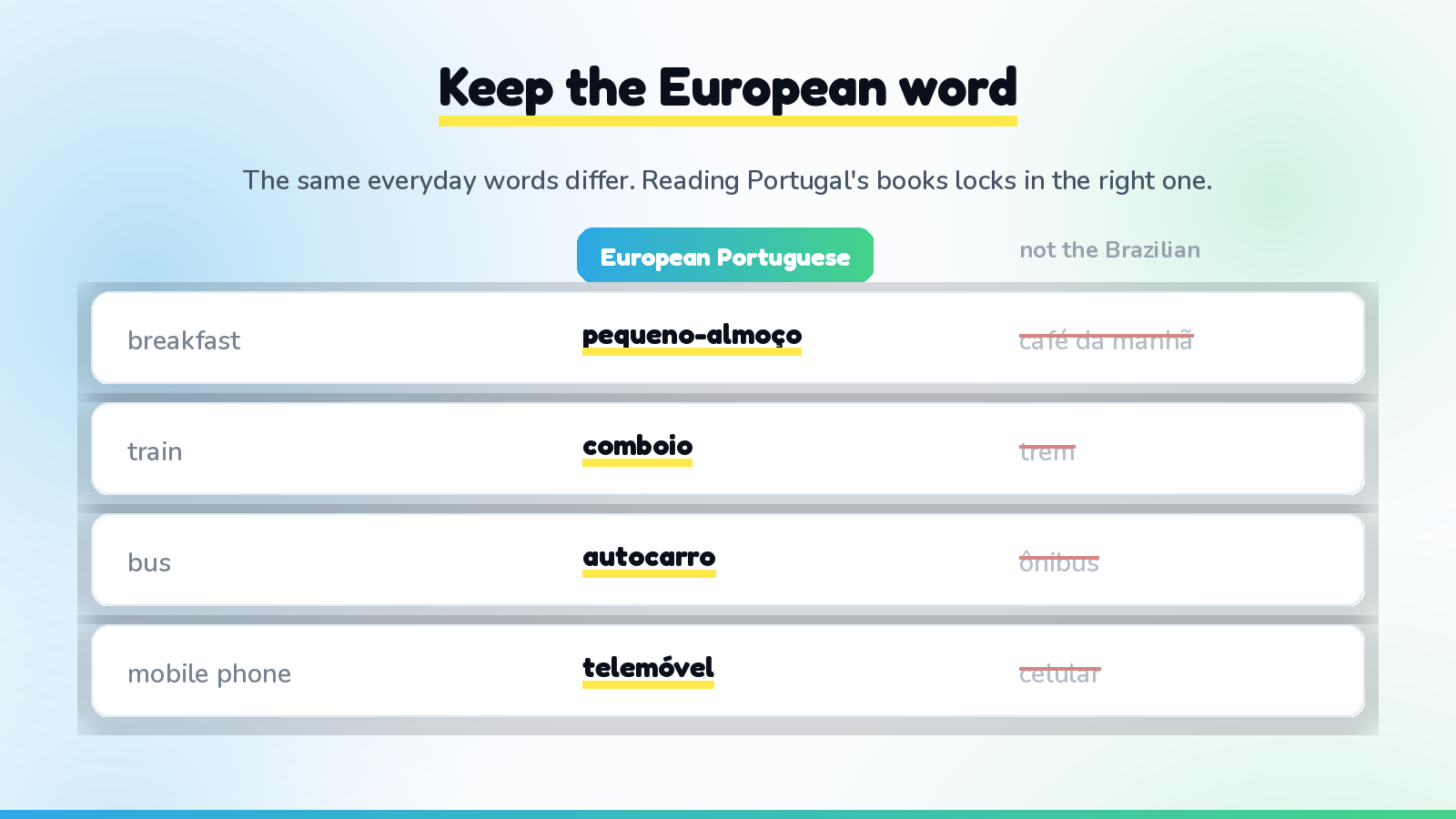
Save the European word, not the Brazilian one. This is the big one. Everyday vocabulary often differs between the two, and reading Portuguese books is how you lock in the Portugal version. You will read "comboio" for train, not "trem"; "autocarro" for bus, not "ônibus"; "pequeno-almoço" for breakfast, not "café da manhã"; "casa de banho" for bathroom, not "banheiro"; and "telemóvel" for mobile phone, not "celular." When you mark a word, you are quietly choosing which Portuguese sticks.
Meet the forms that mostly live in books. European Portuguese writing uses shapes you rarely catch in casual speech, like the personal infinitive ("para eles saberem") and, in more formal prose, the pronoun tucked into the middle of the verb, as in "dar-lhe-ei." These look baffling in a grammar table and much friendlier when you keep the sentence you found them in, because the sentence anchors the strange form to a moment you actually understood.
Watch the false friends. A quick guess gets some words exactly wrong. "Constipado" means having a cold, not constipated. "Puxar" means to pull, which is why every door in Lisbon says "puxe" where you expect push. "Rapariga" simply means girl in Portugal. These are precisely the words worth marking and reviewing rather than waving past.
Build the loop into your week
You do not need a fancy system. Something this simple holds up for months:
- Read most days at a level that feels comfortable, marking unknown words as you go without stopping.
- Once or twice a week, photograph the pages you marked so the new words get captured with their sentences.
- Spend a few minutes on your review whenever it comes due, and let the schedule decide which words to show you.
That is the whole thing. Read, capture, review, repeat. The reading stays the fun part, the capturing takes minutes instead of hours, and the reviewing quietly handles the remembering. If you want the reasoning behind why spacing your reviews out beats cramming, we lay it out in spaced repetition for people who learn by reading.
The takeaway
Building vocabulary by reading in European Portuguese works, and it solves two problems at once. It keeps you anchored to the Portuguese you actually want instead of drifting into Brazilian material, and it shows you words in full that spoken Portugal swallows whole. The only real weak spot is memory, the way a good word meets you in a novel and then leaves without a trace. Fix that single thing, by marking words as you read and capturing them without a mountain of typing, and every book you finish leaves you with more Portuguese than the last. Reading your way into another language too? The same approach works for Spanish and for French.
Ready to keep the words from your next Portuguese book instead of losing them? Start with Vocaboodie and let a photo do the typing.