You have been studying for a while. You can order coffee, follow a slow podcast, hold a wobbly conversation. And there is a novel on your shelf in your target language that you bought with great optimism and have not opened since.
So how long until you can actually read it?
Most answers to this question are useless, because they are given in months. Six months. Two years. It depends. Those numbers are not wrong exactly, but they are unusable, because two people spending "six months" can be doing wildly different amounts of reading. One does twenty minutes on the bus most days. The other does five minutes on a Sunday when they remember.
Here is a more honest way to answer it. Reading is not measured in months. It is measured in pages.
Reading a novel does not mean understanding every word
First, let us define the finish line properly, because a lot of people are much closer than they think.
"Reading a novel" does not mean understanding every word. It does not mean never being confused about who just said what. It means getting to the last page, following the story, and enjoying it enough to pick up another one.
Native readers do not understand every word either. They skim past unfamiliar names, guess at technical terms, and move on. The difference is that they do it without noticing. Your job is not to reach perfect comprehension. It is to reach the point where the gaps stop stopping you.
That is a much lower bar, and it arrives sooner than you expect.
The milestones, counted in pages
Across a lot of learner accounts, the same rough shape keeps showing up. These are not laws of physics, and your mileage will vary by language, background, and book choice. But as a map, it holds up well.
Your first 100 pages. This is the hardest stretch of the whole journey, and almost everybody underestimates it. The first fifty pages of your first book in a new language are genuinely unpleasant. You are slow, you look things up constantly, and you feel like you are getting nowhere. This is normal and it is temporary. Get through 100 pages of anything, a graded reader, a children''s chapter book, a short story collection, and something loosens.
Around 500 pages. Somewhere in here you finish a short, simple novel and realise you read a whole page without stopping. Not the whole book. One page. That is the moment people describe as the first real click.
Around 1,500 pages. Young adult fiction and straightforward genre novels become comfortable. You still meet unknown words on every page, but you are reading past most of them, and the story is carrying you rather than the dictionary.
Around 3,000 pages and beyond. Adult literary fiction, older books, authors with dense style. This is where reading stops being a study activity and just becomes reading.
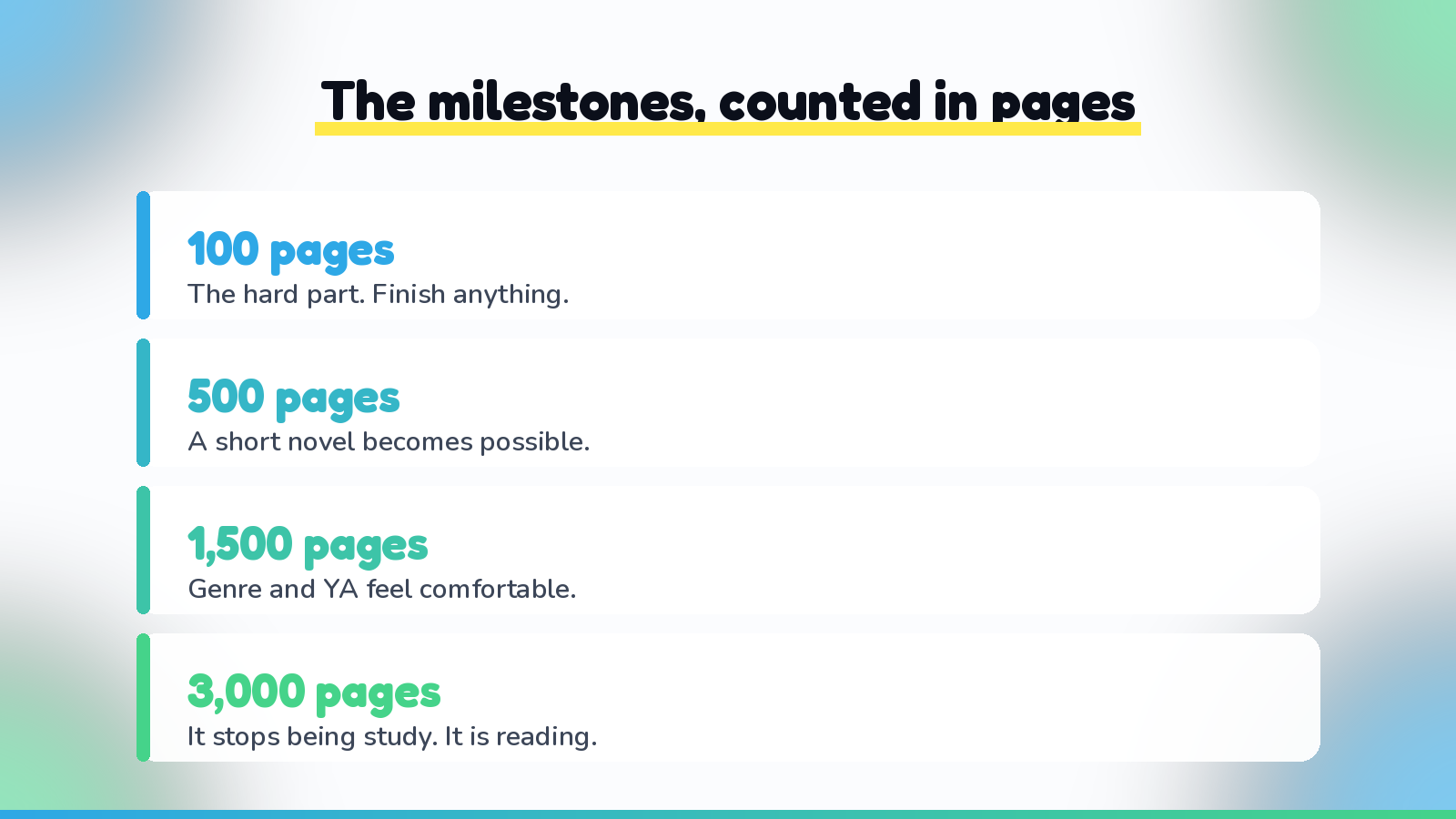
Notice that none of that mentions calendar time. That is the point. The clock does not run on months. It runs on pages.
Turning pages into weeks
Now for the part that makes it real. Take the page count and divide it by your actual reading pace.
Reading speed in a new language starts humiliatingly slow and improves fast. Rough bands:
- Early on, expect somewhere around 8 to 12 pages an hour.
- Once things loosen, 20 to 30 pages an hour.
- Comfortable reading, 40 pages an hour and up.
So let us run the arithmetic on that 500 page milestone, the one where a short novel becomes possible.
Twenty minutes a day, six days a week. That is 2 hours of reading a week. At 10 pages an hour, roughly 20 pages a week. Five hundred pages takes about 25 weeks, so call it six months.
Forty-five minutes a day, six days a week. That is 4.5 hours a week, roughly 45 pages a week at the same early pace. Five hundred pages takes about 11 weeks, so under three months.
Ten minutes when you remember, so call it twice a week. That is 20 minutes a week, about 3 pages. Five hundred pages takes roughly three years.
Same person. Same brain. Same language. The only variable that changed was pages per week, and it moved the answer from three months to three years.
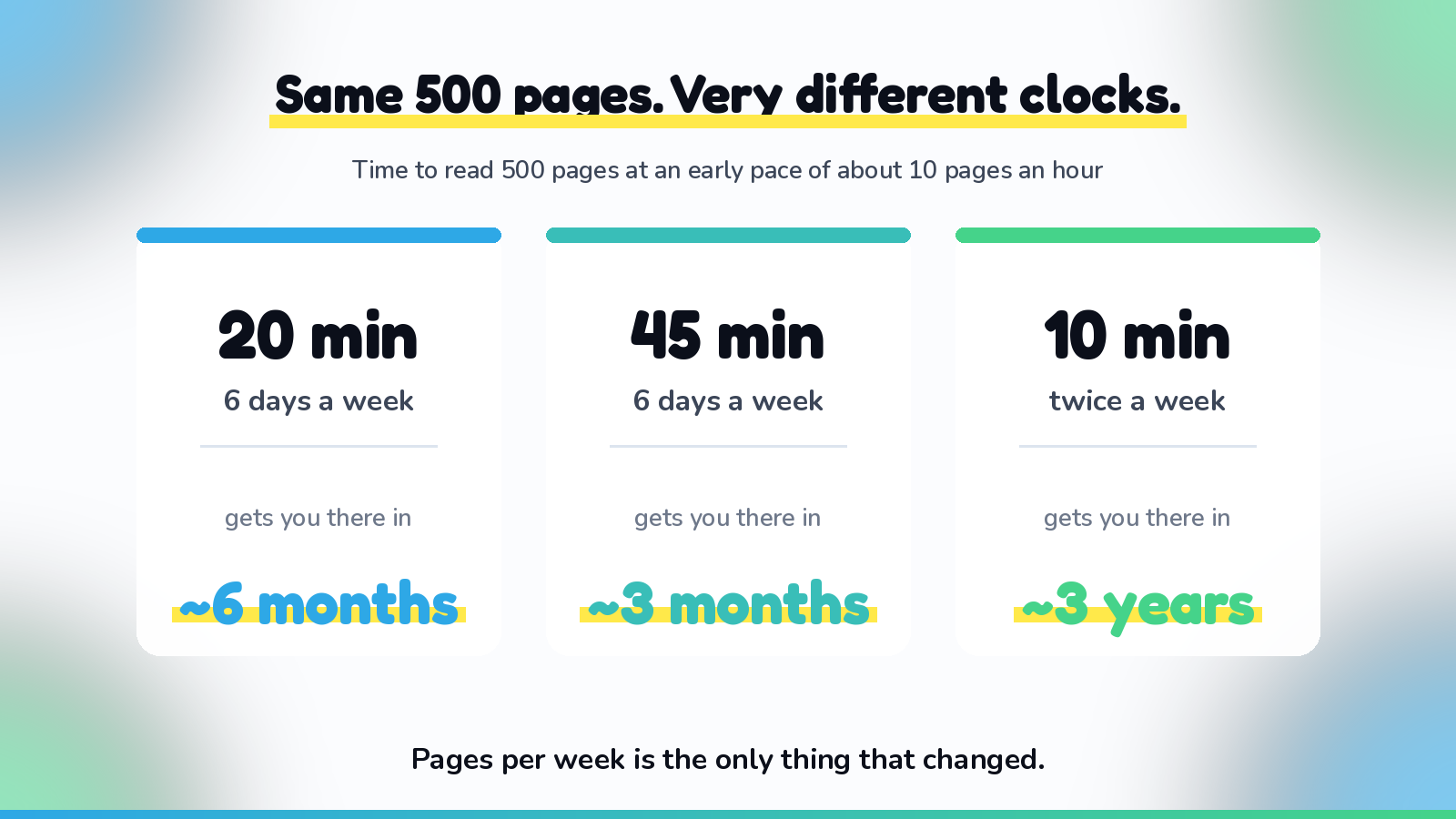
This is why "how long does it take" has no fixed answer, and why the question worth asking instead is: how many pages am I actually reading this week?
Three things that move the clock
If you want the number to come down, there are only three real levers.
One: pages per week. Everything else is a rounding error next to this. Twenty consistent minutes beats a heroic three-hour Sunday, because the heroic Sunday does not happen twice. Attach reading to something that already happens daily. The commute, the bath, the ten minutes before sleep.
Two: the book you picked. This is the lever people ignore, and it is nearly as powerful as the first one. A book slightly above your level pulls you forward. A book far above your level stops you dead, and then you stop reading entirely, and your pages per week drops to zero. If you are not sure how to judge this, we wrote a whole guide on choosing a book at the right level, including a two minute page test you can do standing in a bookshop.
Three: whether the words stick between books. Here is the quiet one. If you meet a word on page 40 of one book, look it up, and meet it again on page 200 having completely forgotten it, you paid for that word twice and still do not own it. Do that across a whole novel and you are working much harder than the page count suggests.
Words stick when you meet them again before they fade. That is the entire trick, and it is why a small review habit sitting alongside your reading makes the pages go faster over time rather than slower. Each word you actually keep is one less speed bump in the next book.
A realistic six month plan
If you want a concrete version to follow, here it is.
Weeks 1 to 6. A graded reader or a children''s chapter book. Do not be proud about this. The goal is 100 pages and the feeling of having finished something. Highlight words you meet twice, not every word you do not know.
Weeks 7 to 16. One short, plot-driven novel. Something with momentum, where you want to know what happens next. Aim for a page a day minimum on bad days, more on good ones.
Weeks 17 to 26. A second novel, ideally by the same author or in the same series. This is the cheat code nobody uses enough. The same author reuses their own vocabulary, so book two by an author you have already read is dramatically easier than book one by somebody new.
By the end you will have somewhere between 400 and 700 pages behind you, which is exactly where the first click tends to live.
Where the capture habit fits
The thing that quietly wrecks this timeline is stopping. And the fastest way to make yourself stop is to turn reading into admin, looking up every word, writing each one on a card, losing the thread of the story, and eventually deciding reading is homework.
So keep the reading part sacred and make the capture part almost free. Highlight as you go, keep moving, and deal with the words later. With Vocaboodie you snap a photo of the page, the highlighted words are pulled out and translated with the sentence they came from, and they drop into a review schedule that brings each one back just before you would forget it. The book stays a book. The words still get kept. That is the whole idea behind making cards from a book the fast way, and there is more detail on doing it without breaking your reading flow in our guide to remembering words from novels.
If you are still deciding what to read on, we compared the capture workflow across formats in e-reader vs paper for vocabulary capture. And if you would rather think about this in terms of vocabulary size than pages, the companion piece on how many words you need to read fluently covers the same journey from the other direction.
The short version
How long until you can read a novel? Roughly 500 pages of practice to read a simple one, and somewhere around 1,500 to be comfortable.
How long that takes in weeks is entirely up to how many pages you read this week. Which, conveniently, is the one part of this you can do something about today.
Pick the easy book. Read twenty minutes. Keep the words you meet. The novel on your shelf is closer than it looks.